
TL;DR—be discerning about AI use, because there’s a good chance that:
for you, personally, the value of the task is the process of doing it;
because it causes you to either learn how to do the task, or grow in adjacent ways as a result of the process;
and, if you’re honest with yourself, you may be cheating, nobody more than yourself (less relevant in work, more relevant in academia/learning contexts).
If you want a better-written piece about AI in academia that doesn’t focus so heavily on the student perspective, I recommend this piece by Prof Jean Fan.
Just like my writing of late, it’s hard to write seriously about this weird moment without being at least a little tongue-in-cheek.
Wait, wait, buster. Surely you use AI?
Sigh. Okay, so let’s whip through some quick disclosures.
Code: I’ve gone on a bit of a journey the last few months. I couldn’t find a workflow that sat well with me at the start of the year. Then, in the early spring, I had some false starts that made me trust the tooling less, which took a bit of thinking to get around—but honestly, the biggest thing that changed was that the models got better.
I’ve got (for me) a pretty efficient workflow as of the time of writing. I’d estimate I can do, in a week, what used to take me about three weeks. Not bad. I can manage about two ninety-minute pairing sessions with an agent in a day, followed by a day of consolidation.
In general, I still write probably more of the code than maybe I should (for the average project), but have also experimented with going full “no typing” and letting the agent make the changes for me. That has extended to whole pieces of tooling, rewrites and even new features.
I still check every line before it is written, which probably means I’m not getting the wild performance gains that others are—but for me it’s more sustainable. I reckon I’m pushing back on between 1/10 and 1/20 of changes as they come up (even if it’s a minor nit), and this more pairing-like process seems to work for keeping the loop tight and useful.
I find that used as a super-grep and memoization tool: “hey robotnik, could you whip through all the org’s repos and see if this pattern is repeated, or a one-off? Has anybody abstracted it into a plugin or library yet?” is incredibly powerful, but I can see that me being in the loop this much is probably already past its sell-by date.
I’m beginning to ask the question: “what would I/we/the org need in order to sleep at night, letting the agents ‘just do this’ once a plan is made?” Some variation on that is the journey we’re all on, I guess.
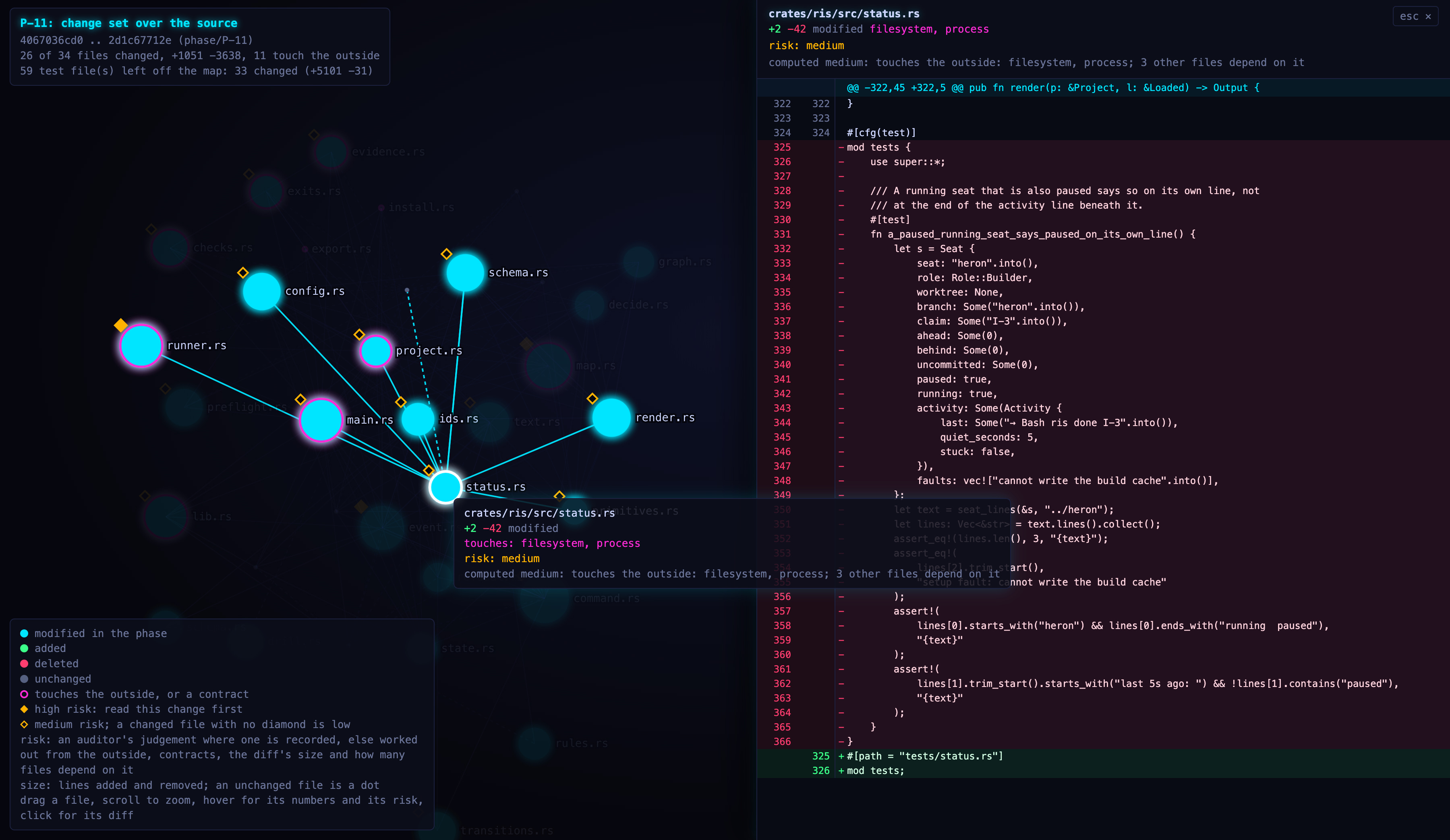
The final note is that in the spirit of challenging my assumption that I need to check every line, I’ve written a harness called Osiris,1 which is designed to keep my decision cost and fatigue low, by automating and judging “mechanical” changes versus “designed” ones. Changesets at the end of a phase are presented visually, tagged by risk, and the diffs can be introspected inline. There’s a repo here.
Academia: After realising a paper review we received earlier this year was at the very least partly written by AI, for the paper I’m currently working on, I had some frontier models generate polite, hostile and medium-hostile paper reviews in the style of the kind of conferences we would be targeting (partly since the draft is early and there’s nowhere currently accepting submissions).2
This, like human reviews, proved very helpful.3
Most of it just reflects back what you’ve already written, but that provokes more thinking, which can’t be a bad thing. I guess I’ve been working on the paper in question for about 10 months on-and-off, so we’re very much at the 80/20 stage, but it took a lot of swallowing my pride to use the LLM in this way.
It has however provoked some soul-searching. If the AI notices something in your argument that you didn’t, and suggests you re-structure, well… although it’s not qualitatively different from a co-author giving the same feedback, it does feel uncomfortable, and it does feel weird.
Unlike in the code case, I find that my interactions with an agent in this space have me bounce off harder—once I’ve got a bit of feedback, I’ll back-and-forth some ideas, get some links and paper suggestions to read, and then the session gets closed, sometimes for weeks.4
That feeling of wrongness is interesting—considering I still write all my contributions by hand, look up things using (mainly) Google or the reference sections of related papers, and I read papers in full myself. Any errors of understanding or authorship are thus my own. As I’ll describe below, I’m basically using it in ‘read-only’ mode, akin to pair programming with a ‘driver’ (me) and ‘passenger.’
Which, ironically, is different from how I use it for code—there I’m both driver, and passenger, in some ways. As anybody who’s paired or whiteboarded with me knows, I have very strong opinions, very weakly held.
So, with those disclosures in mind, I can go on, and you can decide if I’m a hypocrite or not.
The Bit Where I’m Mean About AI
If you (1) used AI for the grunt work,
(2) the grunt work represents a non-trivial component of the overall work,
and (3) you then take credit for it,
then you’re kinda cheating.
This doesn’t apply so much for work in industry, because credit isn’t the point. Outcomes are. I’ll talk about that in the next section.
People are getting degrees, accolades, and any number of rewards that used to come from a combination of careful thinking and hard work from simply outsourcing the problem to AI. In some cases, they have the good sense to think hard about the problem before offloading the grunt work, but in some cases not.
My red-hot take is that doing the grunt work is part of the growth process, and if you don’t do it, you don’t deserve the degree.5
The goal is to learn something, not to be a meat proxy. That usually involves doing the hard typey-type.
If you use AI output for the majority of your final project, be that words or code, maybe you shouldn’t get the degree.6
AI research assistance so you can find papers? Fine. That’s just turbo-Google. Rubberducking with an AI? Fine, if it doesn’t result in incorrect content—the point is that there’s a huge distinction between read and write, as any long-time data engineer can tell you.7
For peak hypocrisy points, I’ll point the finger at myself here—I’ve spent a fair chunk of time at the end of summer and into the autumn pushing a large refactoring drive on a codebase in my research group. The original objective was simply to have a very minimal reference implementation, but when I started finding (very understandable) bugs in the various parts contributed and accreted over time, I realised there were two options:
Fix the bugs, accept there are more that I will not find during the course of my participation in the research group, and ship the MVP.
Use my experience to identify the bugs, abstract the pattern for finding them, abstract the way I was working, and use a frontier model as a lever to stabilising the software, as well as shipping the MVP.
Of course, I chose the latter—at least partly out of curiosity. While it’s by no means been a quick process, there is now a more stable MVP, and it’s lost about a third of its LOC. For an idea of scale, I’d ballpark my bug fix and refactor drive at 200+ hours of my time;8 it has burned tens of millions of tokens, both input and output, or over 1 billion, if you include cache read/write.
However, I already understood the domain, and Rust, and architected the system in question. Sure, lots of small details have come up during the implementation, some of them genuinely surprising, but the key is I haven’t had to juggle the problem of trying to understand the domain as I build in it—at least not as much as if it were a new problem I was attacking.
That means I’m really not sure the approach I’ve taken would be repeatable, and I’m also not sure I would be able to defend a similar workflow applied to another project.
So back to the rant. There’s a knife edge between needing to type, needing to check every output, or being able to let the robot take over, and I’m not sure that front-loading all the context is ever really possible. The only other option is the pure Yegge Thunderdome—loads of agents, loads of tokens, and rely on convergence. I wrote about this a bit already.

It’s Rich Hickey’s “simple versus easy” all over, where “simplex” is a reference to the ability to be non-interleaved and easy means “close at hand.” Picking the close-at-hand option is quick, but results in complexity—interdependency and interleaving, as well as unexpected side-effects. AI makes solutions easy but in many subtle ways it kills simplicity (including the heuristic that, if you do it, you will be the one that learns and grows from it—more on that in a sec).
A hot-off-the-press paper (Galindo-Domínguez et al., 2026) suggests that use of AI has nothing to do with insecurity, peer support, or the confidence of your teachers.9 It’s pure incentives, it’s a rational decision. Thus, you need to take responsibility for your actions. I hope the disclosures in this article show that I’m happy to be clear about mine.
The reason I don’t feel the need for this to be a crusade is because I genuinely believe the main person you’re cheating when you offload all the work is yourself. In my own work, I know the only value I carry forward is what I’ve learned, so that’s what I orient my own practice around.
When I was younger, I really used to believe the “self-improvement is masturbation” line from Fight Club, but with age—and the knowledge that the book is deliberately a nihilistic satire of how young men self-sabotage—I’ve realised that the absolute opposite is true. Obviously.
I’ve heard students only a few weeks out from a dissertation deadline talk very casually about ‘starting the main work.’ I’ve heard a student describe a piece of programming work that would be, probably, a month’s full-time work, minimum, for me (thus, at least two weeks with an agent if I wanted it to be even slightly well thought-through) as something they intended to start now, for a deadline ten days out.
From that point on, there’s only two outcomes: the reader doesn’t really bother reading or evaluating it, in which case, congrats! you won the game of doing no work but getting the credit, or you’ve entered the realm of consumption-as-labour for anybody that reads it:10
Think about the educational implications of this. When a student submits AI-generated work, the teacher becomes the primary meaning-maker, reading, evaluating, interpreting and providing feedback on text no human invested cognitive effort in producing. The teacher’s labour increases while the student’s decreases. The same dynamic plays out when a school leader receives an AI-drafted policy, a parent reads an AI-generated newsletter, a colleague opens an AI-written email, or a student is faced with an AI-generated resource.
I hate to be the cold water, but I can already tell you from experience that the AI heavy lifting will result in code, or a paper, or a dissertation existing. It will however, not be that good, unless you already did the hard miles to “get good” yourself. Even Yegge, operating on full YOLO mode, is very clear that the party still relies on human input, even if he’s tried to take himself out of the loop as a bottleneck for mechanical tasks.11
The only thing that happens if you skip a learning experience disguised as an output exercise, is that a superficial ghost of a text will be created. Perhaps it will pass the sniff test of an overworked examiner.
But then, maybe these pieces of work never were much good, even when people did them the old-fashioned way—see the next section.
Final thought before moving on—in light of some of the big AI labs adding watermarking to comply with the EU’s AI transparency rules, users are complaining that this means users will see their work was co-created with AI, even if they only used it for polish.
Er, yeah—that’s the point. Before, you could pass off your work as your own. Now, you have to disclose, up front, or risk having your work dismissed. That’s called shifting incentives.
Now end-users and readers are more likely to have that information,12 and they can make informed decisions based on it. At the other end, ‘creators’ have to take responsibility for offloading their actual work, and think more critically about their AI use.
I’d call that a win-win.
To those still complaining: as luck would have it, I have the world’s smallest violin, and—hark! It plays for thee.
The Bit Where I’m Ruthless About Outcomes
If the outcome is the artifact, just use AI (sensibly, with discernment) and don’t worry about it. If the outcome is learning, then don’t use AI.
Here’s the thing—students are incentivised to get their degree, then get a job. It has been thus since before I was a student first time around, and I assume it’s basically been that way since the postwar expansion in higher education.
So can we blame people for being rational about their incentives versus the outcomes they’re told to realise?
Not really, but again, it comes down to the fact that, as for most things in life, the work is what you make of it.

When I was a hiring manager in the 2010s, we usually found that on-the-job trained or self-trained engineers of a similar experience level to new CS grads had much better instincts for programming. While possibly it’s about pride in their work or self-selecting, it’s probably also simple incentives. The student is incentivised to (a) do the minimum to juggle their various academic constraints, and (b), graduate (I know I did at undergrad!); while the employed entry-level engineer is incentivised to (a) not get fired, (b) learn, and (c), progress in seniority, which usually has (b) as a dependency.
Universities might argue that students should use AI because it’s more like what they will encounter in the workplace, but I told the previous story to illustrate a point—in my experience they often weren’t prepared for the workplace before the age of LLMs.
Being prepared for the workplace wasn’t the goal. You do that by going out and becoming an apprentice, to learn the actual work. What the students learned at university was algorithms and other theoretic approaches that are incredibly useful when you do need them,13 and are more about knowledge than application.
This is why most of the work-ready grads in the old world came from degree programs that had sandwich years in industry.
Thus the question becomes what the point is of university. If it’s getting a job, then YOLO, do whatever—the ends justify the means, and I doubt university was ever the best job preparation, if I’m honest (although the university grad jobs board was pretty decent at the University of Manchester, if I’m being fair).
I always talk about outcomes being the most important thing to focus on in technical work. If you use AI to shortcut to the outcome of getting your degree, then that’s pretty rational behaviour, as far as I can tell.
The problem cuts to the heart of what higher and further education is in this weird new age—and this tension isn’t a new one.
Are we fulfilling a box-checking exercise, or are we actually training skills? A PhD is supposed to train you to be a researcher, and, frankly, if you don’t know how to—by yourself—write and structure twenty to thirty thousand words without losing the thread of an argument, then I’m not sure you completed the training.
That’s a big ask. I can’t do it (yet), and I’m sure an AI could help, but it’s kind of like making art. The process is the point, and maybe that’s me being old-fashioned, but it’s a big distinction that you need to make on a case-by-case basis. You need to be honest with yourself and make sure that you’re not cheating… yourself.
If I’m writing code (or directing its creation) for a client or academic project, there’s a pretty strong argument for using AI so long as the problem domain is clearly understood, and the solution is thought through—the outcome is the artifact and its successful application to the problem domain.
In my academic code work, I’m part managing and gardening (and fixing!) the work of others, and part adding my own contributions, but I’ve been working on and thinking about the domain for over three years now, so I’m not sure it’s a fair analogy to a shorter-lived industry project or work package.
I will interject that my contracting practice suggests clients expect AI use now—why would they pay for a lead engineer to go slower—but, it’s not a domain you’re an expert in, unlike, say my academic work, where I can sense-check both the code and the math.
There, I can check the code, correct the LLM, and then say, “hey, prove to me, formally, that this matches the specification of the protocol in this paper.”
That’s definitely a bit unlike the normal distributed systems I work on in industry, which have, without exception, lacked a formal definition. I imagine that will change in the coming years.
So, if you think the outcome is better realised using AI tools, then do it, in a methodical way. I’m much quicker when using AI as my turbo-grepper and pairing partner, and the speed-up is real—probably 50 to 100%, even taking into account the fact that after a full day of pairing I normally feel like I need a day off to recover.14
However, to sum all of this up, if the outcome is to learn a skill, then I hate to sound like my dad, but again, you’re only cheating yourself if you use AI.
Still, it’s all in the game, and I can see the ruthless argument for doing it.

The Bit Where I’m Conciliatory and Wrap Up
In certain fields (programming, a lot of the time, and for a lot of my career, if I’m honest), the actual ‘doing,’ insofar as I am referring to the mechanical act of typing, is not really the job, nor has it generally taken up the majority of the time I spent at my desk.15
In my early career, I did a lot of typing before I did the thinking,
and it’s through that process of learning to do, that I learned to think.
In fact, I remember sitting next to a boss of mine on more than one occasion and watching YouTube. Openly. Obviously I was thinking about the problem I had to solve, so threw something on while the gears were turning. This isn’t the sort of thing you see in a film or TV show about slick hackers.
So, as long as you’re doing the thinking, maybe it’s all fine… but here’s the thing. I learned how to write (and this article is fully organic, non-AI content) the same way that I learned how to code. Trial and error. Lots and lots and lots of typing.
Sometimes, in my early career, I did a lot of typing before I did the thinking, and it’s through that iterative and occasionally painful process of learning to do, that I learned to think.16
There’s another counter-argument to this piece, and speaks directly to the subtitle. For millennia we have relied on the written word to memoize approaches, learning and what has been tried previously. Extending this corpus of knowledge is the point of science and research, and nobody needs to remember it all at once.
Is a book just a previous incarnation of the LLM? Is the LLM a reasonable proxy for the corpus? Is Google search in 2005 just the precursor?
I would argue that yes, they are, but the difference is in the use. There’s a hard distinction between offloading the act of doing, and the thought involved, versus using the tool as a research aid or knowledge base.
Read and write. Consumption and production.
If you’re using the tool as a read-only resource, then doing the synthesis and ideation in your own head before creating the artifact (even with some mechanical help), you’re going to realise the value of the learning inherent in the process.
I’m not sure what replaces that process if we say you don’t have to do the hard miles. While I’m a little unconvinced you can internalise anything with just thinking about a problem rather than also grinding out the solution, what do I know?
All I can think is that there’s a reason they say, ‘no pain, no gain.’
First with one agent; now Osiris largely builds itself with Advisor, Lead, and Worker seats, and an Auditor to review each change, and tag items by risk. A couple of times a day, I use the streamlined decision screen to look at the change set (size bounded), merge it, resolve blocker decisions, and then kick off a new phase.
This post took so long to proof, that at the time of doing a final edit, the paper is at a submissible draft stage, and might appear on Arxiv soon; I’ll update with a link when that goes live.
It was however very uncomfortable. For some reason, even though it was similar to other paper reviews from humans where they’ve said something about a missed result implied by what you’ve said… there’s just something about an agent pointing it out rather than a human. Look, I’m bad at maths, and all the changes were already things implied in the text or that a co-author was driving towards (and actually Geoff has been arguing to me about the cost of replication for years, and we’ve written about ledgers representing a commons already), so… that’s less painful I guess, but it’s still uncomfortable.
In fact, at the time of writing, for the paper in question, I’ve not reopened the session in quite some time—it’s possible the agent will get warmed up before submitting to a conference to act a little like a CI check, “is all the logic consistent?” or “is all the notation consistent?” being two very useful tasks, a little like the super-grep in the code case that it’s hard to not use—especially since if you disagree, you can just not adopt any “mistakes” the AI thinks it has found.
There’s also a philosophical question about plagiarism and liability. In order to be able to output what it does, the LLM creator (if it’s one of the big labs) has plagiarised copyright and non-copyright material from millions of creators, including me (as a writer that has probably north of a million words published online). The output of the LLM is by definition plagiarised, and there is a transitive culpability. Plagiarism isn’t allowed when it visibly copies substantial chunks of a work. What if it is just as unoriginal and trivial a contribution, representing no real work or thought on the part of the ‘creator,’ but is assembled from a complex patchwork of others’ thought? The question is whether the ‘creator’ could have done it by themselves. If the answer is ‘no,’ and they expect full credit for their work, then they shouldn’t get it—because they could not have done the work by themselves. Only the plagiarism has allowed them to complete the task. An orthogonal, but interesting variant of this is something a journalist friend said to me—that inevitably these labs must have scraped copyleft code and not attributed it, so has the licensing of the whole metastasised as a result? Are the LLMs already FOSS? I don’t know. IANAL.
This is an inherently hard trust problem. I’ve been working with those for years, and researching them for three, and the only ‘simple’—non complex, or interleaved—solution I have to the dilemma is to say that ‘no AI output whatsoever,’ is the only way to be certain. Hence the ‘read/write’ distinction I make throughout this piece. This gets complex if your co-authors have used AI, potentially without your knowledge. That’s a whole can of worms that I have encountered, and don’t have the space or brainpower to go into here. Co-authors are going to have to use version control like git in future, is my five second shower-thought on that one. Git blame is going to get very real, very fast (yes, that was a pun).
Given that Google search is AI-assisted these days, it’s basically impossible to avoid AI use on the research/read end of most daily tasks now, unless you are using alternative search engines (which, to be honest, is another totally legit position to take).
The usage calculator says 22 days of wall-clock time in active sessions, so whatever that is.
I’m going to quote a huge block of the conclusion, because while it’s a single study, it’s significant if its findings hold:
This study explored whether fear of failure and self-esteem are related to ChatGPT dependence among university students and whether perceived support from fellow students and teachers influences these relationships. Contrary to the four hypotheses proposed, neither fear of failure nor self-esteem proved to be significant predictors of ChatGPT dependence, and social support did not play a moderating role in these relationships. Social support did not moderate these relationships.
A key contribution of this research is the empirical evidence that dependence on generative AI tools such as ChatGPT may not be driven by the same emotional vulnerability factors typically associated with other forms of technology dependence. These findings suggest the need to reconsider existing theoretical models, as conceptual frameworks developed to explain traditional technology addiction may not adequately capture the dynamics underlying AI use. In academic settings, the use of AI tools may be driven more by performance-related and efficiency-oriented motivations than by underlying psychological vulnerability.
These findings have several practical implications. For teachers, frequent use of ChatGPT should not automatically be interpreted as an indicator of low self-esteem or fear of failure among students. Instead, educational efforts could more productively focus on promoting a responsible, critical and reflective approach to AI tools, thereby supporting deeper learning and sustained cognitive engagement.
Obviously for an assessor, it’s probably their job, so kind of fine that it becomes like labour.
This same insight motivated me designing my Osiris harness, which I’ll maybe write about in a separate post.
If they are looking at content generated by a non-open model. Only the big guys will watermark, people running their own are less likely to. Yet another reason that OpenAI and Anthropic are toast.
And actually, in the age of LLMs where typing may not matter so much, are suddenly more important again. But you do still need to be able to look at an implementation and tell the LLM it got something wrong.
Obviously, I rarely get this time, nobody else I know gets this time, and I imagine this is why engineer burnout is skyrocketing.
With some notable and memorable exceptions, such as writing my first web application in one 24-hour stint, pushing for deadlines or fixing bugs, cyberattacks, downtime, etc.
Don’t look back at any of my pieces where I thought I was Lester Bangs—it seems like a phase that all rock music journalists go through.
Hey, thanks for the writing. I sympathise with what I see as a philosophy of immanence running though this piece and wanted to share some of my thoughts:
In many ways, the writing of code "by hand" and the writing of code via code-gen tools, aught to be treated as a difference in kind and not of degree, I think, all else being equal. It's not that LLMs allow you to write more code or better code, it's fundamentally a different way of building software and isn't just a productivity enhancer the way a really good keyboard, monitor and editor might be, who's variability is more a difference of degree (more pixels/comfort/speed). I see LLM tech as a product of industry for industry, and therefore something that has certain things in common with other machinery.
Where I perhaps differ from your take, is that I think the human is still the one *doing* in both cases as that is ultimately who is applying judgement and taste. I would therefore be of the controversial opinion that art (and code) /can/ be created using AI models, since the distinguishing factor between a good artist/programmer and a bad one is good judgement and taste, not that a paintbrush or purely key strokes were employed.
They do however employ very distinct methods that produce a very different outcomes and programmers. So much so, that I don't think it's possible to directly exchange one for the other. With the artist, there is even less fungibility as the artist is a proprietor of his or her own technique, unlike the programmer, who generally speaking, has to adopt a more standardised technique that is the property of industry (unless of course you're someone like Johnathan Blow or John Carmack and have the freedom to break the rules...).
A crude example: the automatic loom.
I think it's fair to say that with the development of the automatic loom, the level of productivity increased massively, but at the same time, what is possible was changed at a fundamental level. It's clear that with the loom, you can't make the same patterns as you can with manual weaving, but it does excel however, at making lots of cloth with repetitive patterns. It doesn't mean there is now no possibility of originality, it just means that there is a constraint on the possible that shapes all subsequent decisions, and it favours high and similar output over unique and bespoke output. But why go for the bespoke if you can go for volume?
Going back to Blow and Carmack: if I set out to make a game engine using AI, I'll probably be pulled towards a rather standard mean at every turn, and only by applying firm and decisive judgement, will I move away from that mean. Even the game engine itself, will shape what games can and will be made. You kind of have to shape things from the ground up as you go and apply creative judgement to end up anywhere truly new, or at the very least, take a sharp turn at some point.
I think industry under capitalism favours standardisation and has a tendency towards averages (whatever the system can tolerate), and that partially explains the proliferation of AI software development. It was already "standardised"* before AI came on the block... and now there is a tool that can leverage that tendency towards means. Why are we here? I think it's because industry has little interest in creating anything new as long as there is profit to be made doing or recycling the same thing. Costs will be slashed to increase margins before there is any genuine push to make something new. Why risk failure when you can get comfy and profit from a monopoly/duopoly? It's only when that fails due to stagnation, that a research output from academia will be appropriated.
I find AI genuinely powerful and useful but a clear product of industry/capitalism and nothing inherently 'good'. This where I perhaps differ from Doctorow's idea of "enshittification". I don't think Google was ever 'good', it first grew to be sold to other search portals, and then as a vehicle to sell ads (not far from incorporation), and ended up what it became as a result. So I perhaps differ from his 3 stage process that suggests that innovation starts to provide something explicitly 'good'. Different choices would be made if it was a democratic one or at the very least free from the logic of profit.
I think if you want to truly break the rules like Blow or Carmack, you need to start from the ground up, or at the very least take a sharp turn and be free free from the constraints of profit and efficiency, and ultimately do things for the benefit of society, or for the sake of a creative impulse or passion, lest everything that makes your thing unique be shaved off until it can be accepted by the market.