
This post is less work-related and more personal than the usual. I had half a draft of something on 633 Squadron and decided that current events made me want to finish it.
I genuinely believe that we have a patriotic duty to defend England against Reform. Against Trump. Against Putin.
There’s a by-election in my constituency and it looks like it will be two-way between the Greens and Reform. Suddenly I have a lot of skin in the game, much sooner than I had anticipated. I’ve also realised that on some level it’s patriotism (cringe) that makes me want to defeat Reform so much.
The Battle of Britain was S-Tier Antifascist Action
I’ve been interested for some time in a patriotic left-wing movement against the Far Right. I’m unashamedly left-wing, except for a slight hawkish streak on defence—which perhaps the current state of things has helped to validate—but grew up, like many people in England, on stories of the blitz, the Battle of Britain and films like A Bridge Too Far, 633 Squadron,1 and Where Eagles Dare.2
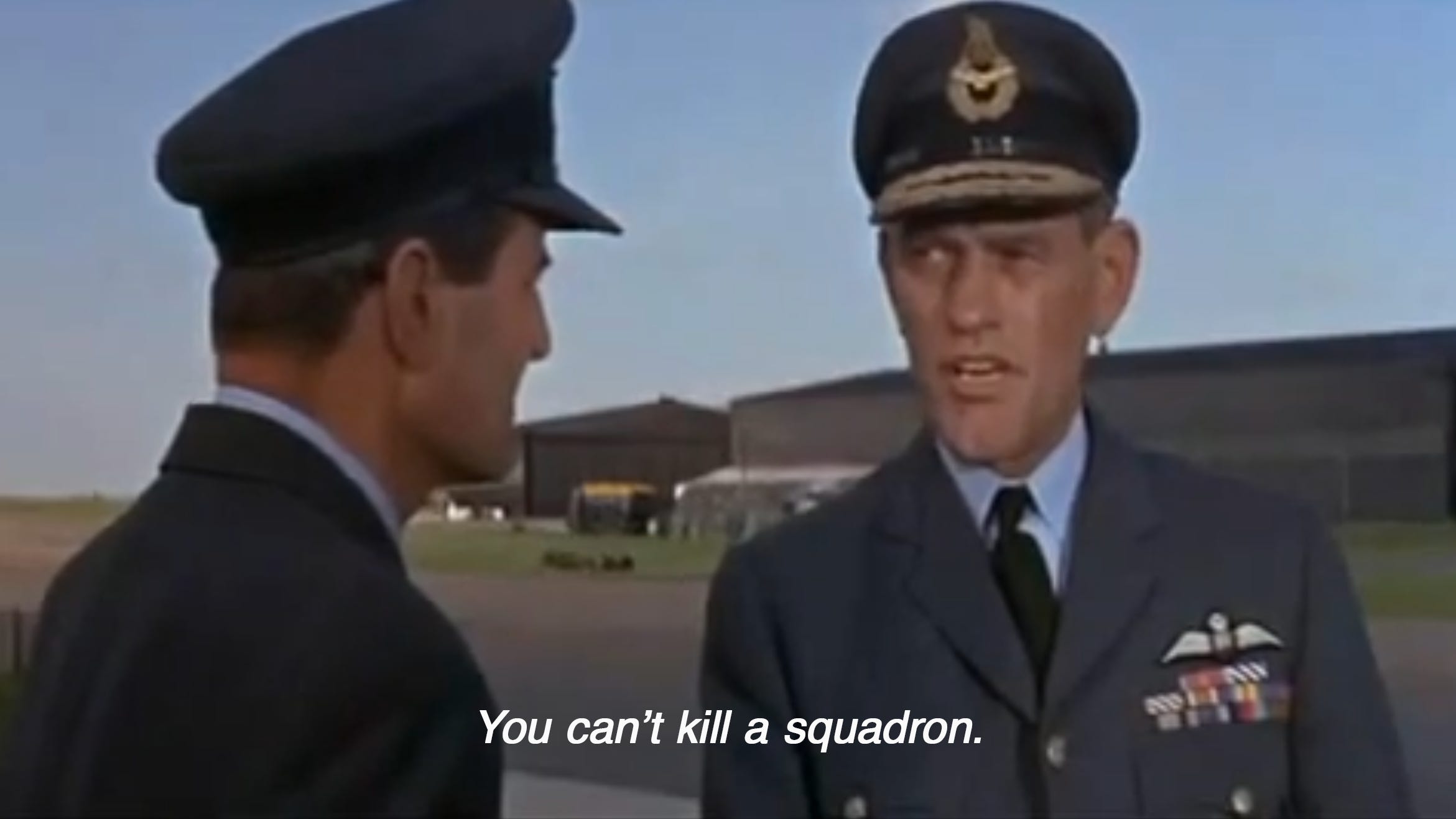
Now, perhaps it took me too long to have this thought, but my entire adult life has been taken up by the right claiming exclusive rights to the imagery and legacy of British involvement in World War Two. Last time I checked, World War Two was the greatest struggle in history against the extreme right, so at what point did it become weaponized by those that want to foist authoritarianism upon these isles?3
Though I’m no nationalist, and I’m a bit shy of ‘devoted’ to my country, I’m definitely a pragmatic patriot. I’m proud to be English, British, European—in spite of the bad parts—but feel that admitting this is somehow problematic due to the behaviour of many of the most performative, far-right “patriots.” That’s a bit weird, isn’t it?4
It’s in this context that I genuinely believe that we have a patriotic duty to defend England against Reform. Against Trump. Against Putin.5 I’m being deadly serious.

Identity and the Social Contract
There’s a chance this thing doesn’t get too out of hand and it remains a spiritual struggle, confined to the ballot-box, but that requires acting together and acting for the good of the country.6 You wanted blitz spirit? That’s what I’m selling. Let’s chuck the chancers out and rebuild a country of agency, opportunity and decency, without having to go through the bloodshed required to form a social consensus last time around.
“So here’s two cheers for a place called England, sore abused but not yet dead”
The question is, what’s the smallest thing we could put to paper and all agree on? That we want to build a better country? That we want to build a better tomorrow? Less? Just that we want to build anything that is real? We need to find that shared hope. That’s the kernel. Then we can ask the question: where can we go from there? It’s definitely a huge task.
If I had to guess, I think Maggie Holland might have an answer in her song A Place Called England.7 At the moment, the country is “Run by men who think that England’s just a place to park their car.”
I’m taking a stab in the dark, but I think that’s a statement that both disaffected Reform and Green voters could agree on. I’m going to self-indulgently quote two whole verses of the song:8
And come all you at home with freedom, whatever the land that gave you birth
There’s room for you, both root and branch, as long as you love English earth
Room for vole and room for orchid, room for all to grow and thrive
Just less room for the rich landowner, he can stay in the Virgin IslesFor England is not flag or empire, it’s not money, it’s not blood
It’s limestone gorge and granite fell, it’s Wealden clay and Severn mud
Blackbirds singing from the May-tree, lark ascending through the scales
Robin watching from your spade and English earth beneath your nailsSo here’s two cheers for a place called England, sore abused but not yet dead
We need ideas and action, not the neoliberal sound-bites and stasis of Labour and the Conservatives, and not the reactionary, millionaire-funded, self-interested dross of Reform.9 In fact, even the Left doesn’t really have any answers for this one, because it’s not about the political spectrum, and I’m not even sure it’s about a specific policy,10 it’s about who we are when we are together. England. Britain.
The flip of this lack of narrative control over patriotism by the left is the state of the Conservatives—somewhere I’ve drafted a post about the social contract in Jack Aubrey’s navy, which is really I suppose about one-nation conservatism, or old-fashioned patriarchal Tories. Maybe you can’t have a coherent answer to the far-right unless you have a coherent right-wing.11
Both the left and the right have to rebuild the social contract, and give people the space to decide who we are together when we face challenges together. There’s no shortage of challenges, even if there is a shortage of political will to face up to them.
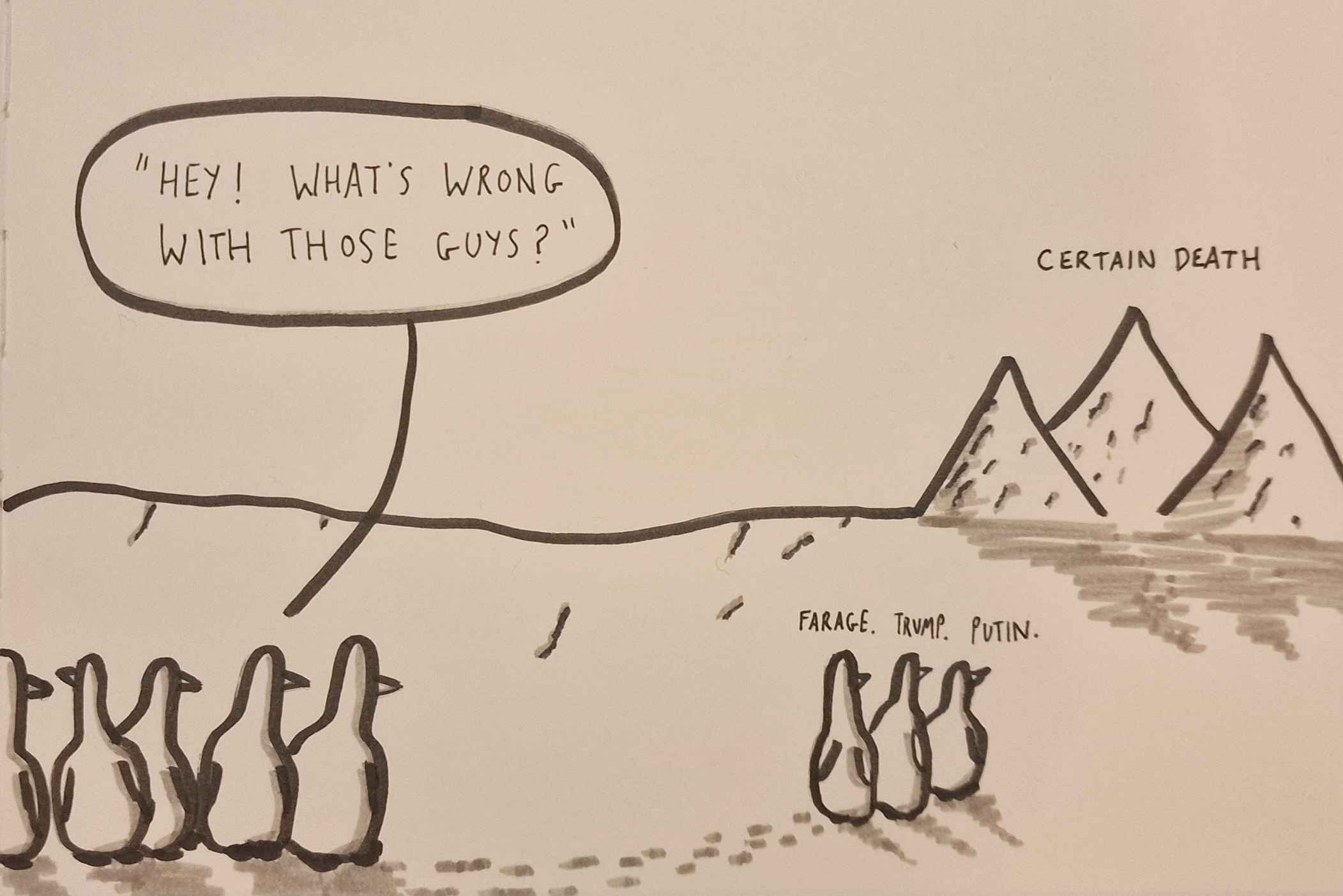
Returning to the most immediate challenge, if the current right is Reform, then after the bizarre penguin episode in London12 I think we have to start asking the question, not only whether they are just dangerous,13 but whether they are in touch with reality at all.14
Regardless of how this all pans out, I think at our best, we’re braver, bolder, and more resourceful than the political class that fear making real decisions about the future believe we are. I also think we’re more human, more prepared to sacrifice, and more capable of cooperation than the cynical opportunists allow for either. Most people are just waiting for an opportunity to show it.
I’m a bit less constructive by nature than the Young’uns—too many old war movies, I guess—so I’ll end with a snippet of a rousing song:
Our ship being cleared, the foe we neared, with expectations high
That we should show the murd'rous foe
That British courage still will flow
To make them strikе or die!
—The First of June
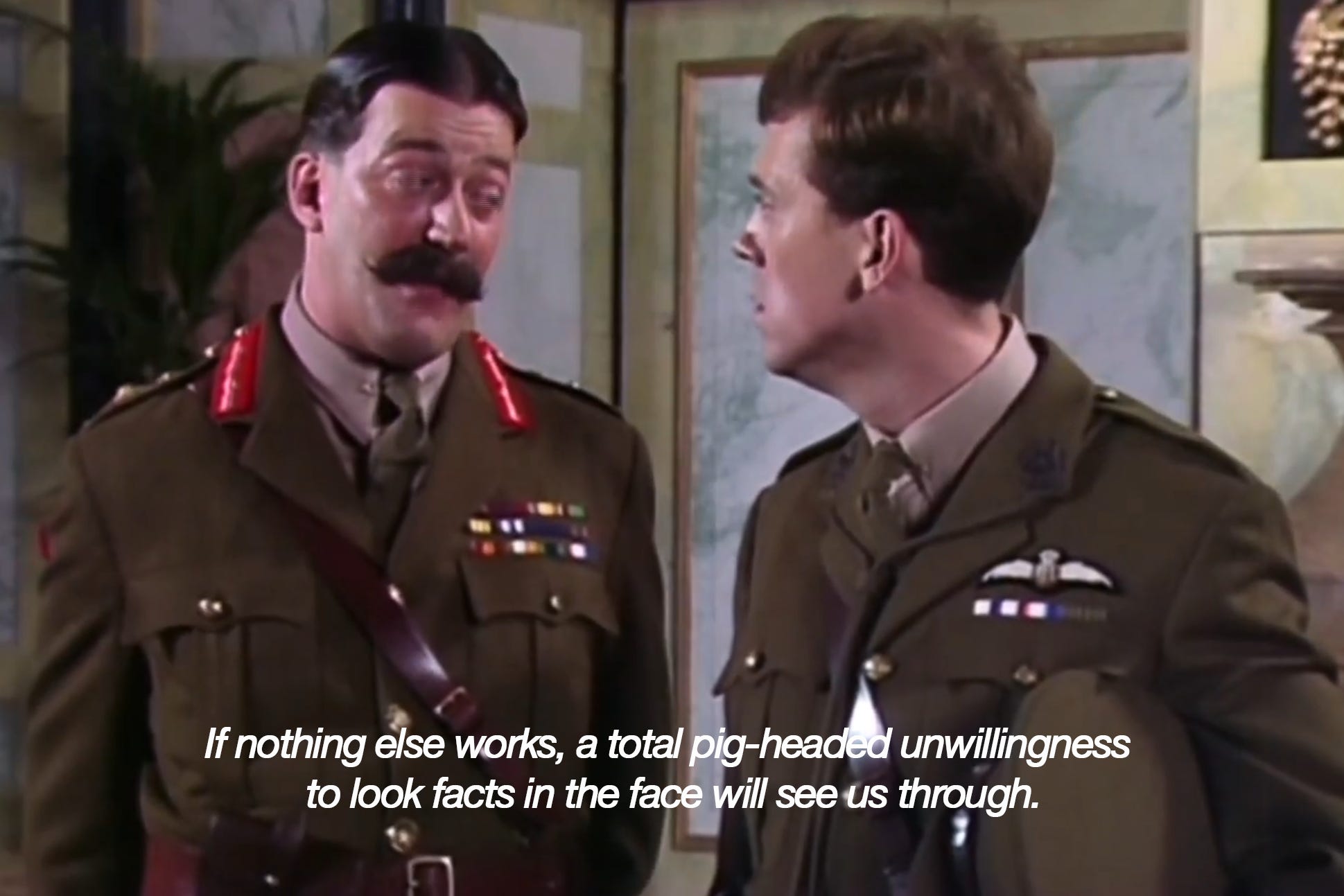
The ending of this film (image above) always reminded me of this moment from Blackadder. I think it’s telling that the arch neoliberals like Michael Gove seem to hate it.
That’s before we talk about what in my house is called the ‘Nelson shelf’—a lockdown joke that got out of hand and now has the complete Aubrey—Maturin and Hornblower series, as well as biographies of Nelson (as well as his collected letters) and Cochrane, various Marryat novels, and of course, James’ Naval History of Great Britain and the Naval Chronicle. In hindsight it’s obvious this would get out of hand to the point of writing a book, but I digress…
Okay, a reasonable counter-argument here is that authoritarianism in everyday life, where people feel it, is already rife in Late Soviet Britain (see Dr. Abbey Innes’ 2023 book of the same name). Neoliberalism in the UK has ironically, and ultimately taken the form of the degenerate state-planning of the late Soviet system, even as it refuses to die or evolve into something that better serves the people of this country.
And yes, I’m far from the first to voice this frustration.
Just as in the Office meme, “they’re the same picture.”
Oof, cringe.
Though the version by The Young’uns might be even better as a performance—perhaps I’m biased, since I heard their cover first.
This is the Young’uns version so the “sits on his arse in his 4x4” line is replaced with “stay in the Virgin Isles.”
And gosh darn is this easy and uncontroversial to type, and gosh darn does it solve not a thing.
Okay, my reddest hot take is that we should bring back national service (maybe you have to do military, forestry conservation-type work, or perhaps specific charitable work, like working at a food bank—I’m out of my lane here, others can figure this part out later) where regardless of background you have to live away from home with people from all walks of life. I want to see the private school lads that I knew growing up (I went to state school, but, long story) digging ditches in the Lake District with the lads from Manchester I sit next to on the bus. Yes, this would cost money and require logistics, but that’s true of all important initiatives. It’s about bringing people together who would never normally meet, combined with a bit of semi-manufactured hardship.
In fact I strongly suspect this is so. Then again, resistance against authoritarianism might be independent of all of this, based on the accounts in Rutger Bregman’s Moral Ambition, where opposition to the Nazis in (if I’ve recalled correctly) the Netherlands did not follow class, religious or other lines. As Tim Hartford summarizes, “There were some predictive factors, such as independence of spirit. But the heroes seemed much the same as anyone else. The only obvious distinction was the vital one: they took extraordinary risks to save others, while others did nothing.”
I’d recommend the Folding Ideas video on the bizarre situation. Two things it reminded me of were the documentary Praying for Armageddon (iPlayer Link) which explicitly investigates the ‘death cult’ impulse in present US politics via the lens of radical evangelicals, and the fact that, as one of the YouTube comments points out, the penguin walking off represents a zero-sum worldview (more on that in future post). Additionally, putting one’s ego first instead of what is literally in your own self-interest is a classic narcissist move. More on that in the same future post.
They are.
They aren’t.