
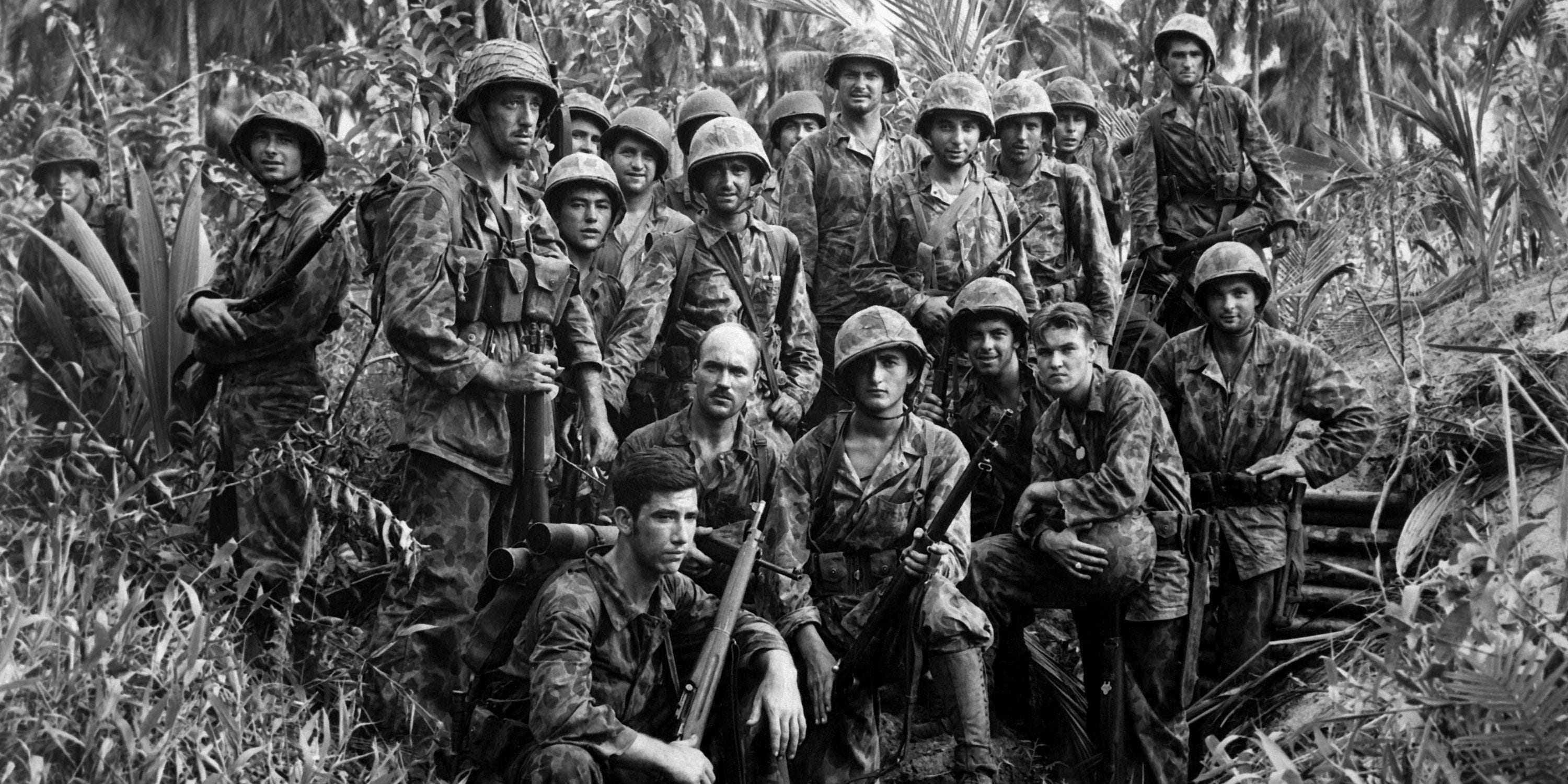
I came across Evans F. Carlson a few years ago and was fascinated by his story. During WWII, the US military established what was essentially the first US special forces unit,1 the Marine Raiders. They created two Battalions, and gave their commanders extensive leeway in their organisation and tactics. Merritt Edson was given command of the 1st, organising it along the lines of existing unit doctrine, and Carlson the 2nd.
Carlson structured his unit more unconventionally than Edson. As an observer, he had seen the Chinese Communists fighting during the Chinese Civil War, and had been surprised by their effectiveness. He took from this two lessons—the importance of an éspirit de corps based on co-operation, and their size of unit organisation, which was typically 3 fighters:
Carlson used egalitarian and team-building methods: he treated officers and enlisted men with minimum regard to rank as leaders and fighters, gave his men “ethical indoctrination,” describing for each man what he was fighting for and why, and used the Chinese phrase “Gung-ho!” as a motivational slogan which he learned from the Communist forces during his years in China. He also eschewed standard Marine Corps organization, forming six rifle companies of two platoons each, and innovating 3-man “fire teams” as its basic unit. (Wikipedia)
The best thing about this story is the etymology of “gung ho,” which became a war cry for the US Marines as a whole after a propaganda film of the same name about the Makin Raid.
Carlson explained in a 1943 interview: “I was trying to build up the same sort of working spirit I had seen in China where all the soldiers [of the Eighth Route Army] dedicated themselves to one idea and worked together to put that idea over. I told the boys about it again and again. I told them of the motto of the Chinese Cooperatives, Gung Ho. It means Work Together — Work in Harmony.” (Wikipedia)
However, Carlson was mistaken. The phrase is simply an abbreviation for ‘industrial co-operative.’ Still, the fact that he adapted what he thought the phrase meant for a fighting unit is interesting.
After assembling two more Raider battalions, the force was consolidated into the 1st Marine Raider Regiment, with Carlson as executive officer. His 2nd Battalion was returned to ‘normal’ structure, but his ideas were adopted first by the Regiment, and then the whole Corps.
Carlson's 3-man fire team and 10-man squad organizations were adopted, first by the Raiders and then by the entire Marine Corps. Edson contributed the concept of a highly trained, lightly equipped force using conventional tactics to accomplish special missions or to fill in for a line battalion. (Wikipedia)
It’s the last point of that paragraph which hints at the ultimate fate of the Raiders experiment.
The reality was that in the Pacific war, there were relatively few opportunities for true Commando-style raids. Increasingly, landings were done in force, using amphibious tractors, and what was needed were more line Marine units. Moreover, the lightly-armed, specialized Raiders were disliked as an ‘elite within an elite’2 by some senior officers, and the 1st was eventually redesignated the 4th Marine Regiment and brought back in line with standard force organisation.3
Enter Robin Dunbar
Though the Raiders themselves were relatively short lived, their experimentation had a lasting effect, as well as being correlated in other areas. The 3-person structure crops up over and over—in terrorist cells4 and, subsequently, in the standard force organisation of most NATO militaries, where the smallest atomic unit is typically a fire team of 3-4 personnel.
This perhaps makes sense for a reason—Dunbar’s number. Though the methodology and conclusions have been disputed, I think the theory behind it has become so widespread because people can look around them and see some correlation between real life and theory.
The reason you will probably have heard of it is the idea that you can at most maintain about 150 meaningful relationships.
However, the model is stratified, and was developed by further research. Although most people will think of the smallest ‘circle’ of relationships as 5, there’s actually an inner one, 1.5.5 If we round this up to 2, we can see that one person with two close relationships adds to 3.6
For completeness, here are the layers:7
1.5: Intimates/Inner sanctum
5: Loved ones
15: Good friends
50: Friends
150: Meaninful contacts
500: Acquaintances
The takeaway is this: you don’t have to deliberately always structure around these numbers,8 but it maybe pays to be aware of them. When your teams break, consider if it’s because of crossing a threshold, or due to other external factors.
Finally, always remember that if in doubt, 3-4 motivated people can almost always get the job done.
I imagine there’s an even earlier example than the UK’s LRDG, which was the forerunner to the SAS and Commandos (Bernard Cornwell certainly wants you to believe the green jackets qualified during the Peninsular War), but that’s the one that comes to mind as first true special forces unit. Certainly the Marine Raiders were set up in response to the success of ‘Commando’ tactics.
“[H]andpicked outfits” were “detrimental to morale of other troops,” according to one. A better argument is simply that the training was wasted, due to lack of opportunity to use it, or indeed the fact that lightly-armed, light infantry in pitched battles could result in greater casualties for those units. Though there were some famous raids, such as Makin, it is true that the majority of the Raiders’ missions were the same as other line infantry battalions. That’s not something you can say of the LRDG, SAS, et cetera.
Which, obviously, would be eventually organised along Carlson’s lines anyway. So arguably, the most valuable insight was grandfathered in.
If memory serves, this is referred to by Jeffrey Norwitz in this book.
I think I first heard of this at a philosophy evening sometime in the late 2000s or early 2010s, so I assume that must have been around the time of Dunbar’s additional research.
Alternatively, assuming 5 is a statistical average, 3 is on the lower-end of the bell-curve for that band. Alternatively, given the layers are nested, it’s worth considering 5 as nested sets of 2 + 3—meaning the second layer could be a person plus 3 connections, or 4 total members of the social graph (unit).
Dunbar himself said there were variables that affected these including survival pressure, economic factors, extraversion, et cetera—so I’m knowingly hand-waving a bit.
It’s also important to remember that since they’re nested, imagine your employee is young, they have a housemate and 5 close friends; thus they have about 9-10 peoples’ worth of ‘good friend’ slots left for people they interact with a lot (and of course they won’t get on with everybody on a team). I think this is why a lot of teams sort of fall apart at the 10+ mark. The other reason is simple—a full peer-to-peer mesh follows a power law for number of connections, so it’s just a question of cost of coordination (mental cost and dollar value).