
Let’s try and solve a literary riddle: which of the disordered personalities from our last post is Iago, the antagonist in William Shakespeare’s Othello, possibly the greatest villain ever put to paper?1
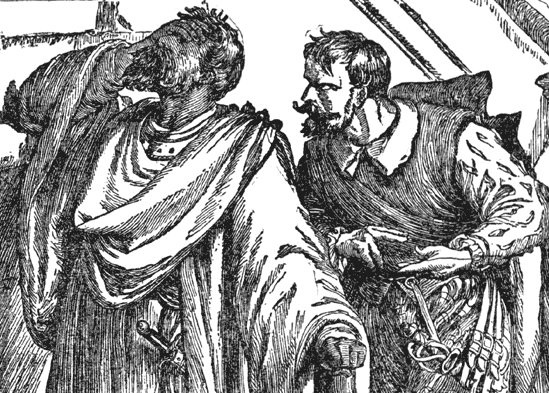
Ostensibly, he’s a Machiavellian, as he reveals in his first long speech. He first reveals his purpose to his sponsor, Roderigo,
O, sir, content you;
I follow him to serve my turn upon him:
We cannot all be masters, nor all masters
Cannot be truly follow'd. (Act 1, Scene 1)
Then winks to the audience that Roderigo will also be destroyed as part of his vendetta against Othello:2
For when my outward action doth demonstrate
The native act and figure of my heart
In compliment extern, ‘tis not long after
But I will wear my heart upon my sleeve
For daws to peck at: I am not what I am. (Act 1, Scene 1)3
Roderigo fails to understand that all of the betrayal Iago wishes to land on Othello, he will first land on Roderigo. Roderigo is so focussed on obtaining Desdemona’s hand in marriage (and later, getting revenge on Othello), that he does not interrogate the motives of his co-conspirator.
Iago resents the fact that he needs Roderigo, “thou, Iago, who hast had my purse / As if the strings were thine,” and the asymmetry of power with a man he considers his inferior:
Thus do I ever make my fool my purse:
For I mine own gain'd knowledge should profane,
If I would time expend with such a snipe. (Act 1, Scene 3)
The thing is, Roderigo is more stupid than Iago, so I don’t think that’s also immediately evidence of Narcissism. However, Iago famously has several monologues where he reveals mutually exclusive, contradictory motivations for seeking to destroy Othello. There’s jealousy of social status, an accusation that he has been cuckolded,4 and ostensibly just plain boredom,5 at various points, and sometimes within the same speech.
Put all of this together, and while Iago has many traits of the Narcissist—a certain grandiosity6 and incredible sensitiveness to attack (which we see every time he lays out his motivations), his self-discipline in carrying out his programme of revenge is more like that of a Machiavellian. Since Psychopaths also have some grandiose traits, I think we can probably assume Iago is mainly a Machiavellian Psychopath, though it’s possible he is a full Dark Triad personality.7
So, there you have it—hard to call in the end, and that’s why Iago is such a multi-dimensional villain.
Yes, I am really arguing that the whole point of Othello is Shakespeare warning us about disordered personalities.8 There’s a reason he’s the GOAT, okay?

Though there have been many incredible stage productions, and on the page the character is still powerful, he’s been very indifferently represented in film. Kenneth Branagh’s portrayal was a low point.
Famously, he also warns Othello against his own downfall, knowing that his fair counsel will cement his position and thus speed Othello’s fall, “O beware, my lord, of jealousy; / It is the green eyed monster which doth mock / The meat it feeds on.” (Act 3, Scene 3)
This is also a major foreshadowing: only at the very end of the play is his true malevolence revealed, and he is sentenced to death, thus making this passage a perfect prediction.
“it is thought abroad, that 'twixt my sheets / He has done my office: I know not if't be true; / But I, for mere suspicion in that kind, / Will do as if for surety.” Act 1, Scene 3. Interestingly, Iago’s wife Emilia is often played as a bit of a flirt, and I think that misses the point. She’s clearly in an abusive relationship, and it’s their relationship that has the clues to Iago’s true nature—he’s passive aggressively damned both her and Othello with no evidence, and so playing her more neutrally is a more powerful directoral move, in my opinion. That she helps Iago to some extent with his plans is perhaps a classic Narcissist—Codependent relationship. Iago returns to the theme of cuckoldry with a desire to cuckold Othello, and a renewed accusation, in his monologue at the end of Act 2, Scene 1: “And nothing can or shall content my soul / Till I am even'd with him, wife for wife.”
“But for my sport and profit. I hate the Moor” Act 1, Scene 3.
His very first stated reason for hating Othello is promoting Cassio in his place, after all.
As I mentioned in footnote 6, there’s an argument that Emilia and Iago’s relationship reframes him as a Narcissist, which, added together with Machiavellian and Psychopathic traits would make him a Dark Triad personality.
Thanks for coming to my TED talk.