
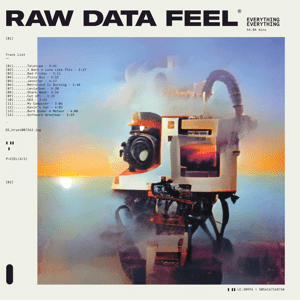
On May 20th, 2022 the British art pop band Everything Everything released their sixth album, Raw Data Feel. In some ways, it was a return to form. The band (unfortunately) had had more misses than hits in their two preceding records.1
I heard this song and realised that we had collectively believed our own hype.
There’s a track on it that hit me like a truck, Track 11, My Computer.
Some of the lyrics on the album are nonsensical even by EE’s oblique standards, and that’s because their lyricist, Jonathan Higgs, was experimenting with generatively creating them:
“With assistance from Mark Hanslip, a musician and researcher at the University of York's Contemporary Music Research Centre, Higgs developed an AI bot dubbed ‘Kevin,’ named after a recurring character in the album, to compose song lyrics generatively. Higgs fed it four different sources of information—LinkedIn's terms and conditions, the epic poem Beowulf, 400,000 posts from the message board 4chan, and the sayings of Confucius—before compiling and tweaking the results into usable material. Ultimately, the bot contributed roughly 5% of the album's lyrics and a song title (‘Software Greatman’), receiving a songwriting credit in the process” (Wikipedia)
So eccentric is Higgs’s lyrical style that I’m not actually sure whether either of the chorus’ two variations is purely his mind, or the generative model:
‘Cause you can bend, you can slide
You can push me to my limit
You can run, you can crush
Every blue boy on the planet
You’re in love with the future, I don’t know why
You’re in love with the future, I don’t know whyAnd you can hide, you can seek
With that ultraviolet ammo
You can sing, you can play
My ribcage like piano
You’re in love with the future, I don’t know why
You’re in love with the future, I don’t know why
The line, “you’re in love with the future, I don’t know why,” came to embody everything about the chaos that had overtaken my working life.
At the time, the Juno blockchain was navigating the tail end of the Proposal 16 insanity,2 when a governance process had attempted to seize $120 million worth of tokens, and I had spent something like 2 months 24/7 firefighting, trying to broker a compromise, talking to lawyers, dealing with a zero-day cyberattack that halted the chain, and somehow running my business.
There’s nothing wrong with being where the action is, but when things are exploding is when you need to be at your most critical, honest, and level-headed.
The perils of being close to the bleeding edge and saying, “damn the consequences” had never been more real, and this song was a reminder that most of the time at the frontier, you’re surrounded by gamblers—and are probably one yourself. There’s no safety in numbers, and just because you’re where the action is3 doesn’t mean you’re collectively right.
I heard this song and realised that we had collectively believed our own hype. In uncritically believing our technology was the future, we’d committed that cardinal sin that always leads to destruction: hubris.
In 2021 we’d needed that uncritical, enthusiastic energy to launch projects, often working for free, collaborating with idealists, chancers, gamblers, founders, degens and everybody in between. The blockchain ecosystem was always more varied in its personalities, ideologies, politics and opinions than its critics gave it credit for, and everybody needed to—and largely did—pull in the same direction.
However, by late spring 2022 the cracks were showing. Projects had launched, rivalries had surfaced, money had been made (unevenly) and it was time to pony up the use-cases. At just the time when the mood needed to shift a little to be more self-critical, it had become even more hysterical.4
At that time, the Cosmos experiment with DAOs was hitting the buffers. It wasn’t Juno that poisoned the well of Cosmos—depending on how you look at it, that was either the Terra/UST collapse, or the effect of continued high interest rates,5 but in hindsight, the writing was on the wall. The summer that followed was probably the last time that most validators in that ecosystem were consistently in the green.
What this experience left me with was an apprecation of two things:
To get an outsized return on the energy you expend, you have to be where the action is; however
People where the action is are by definition gamblers, so be extra skeptical of their claims, and bear in mind their risk tolerance might not be the same as yours, or as society’s.
This is extra relevant in the current AI maximalist world we live in—to be where the action is, you’ve got to pick up your shovel,6 and head in that direction. However, I’ve seen first-hand what happens when skepticism is abandoned and wishful thinking takes over.
If that wasn’t the lesson of Proposal 16 itself, then it certainly was the lesson of everything that followed. There’s nothing wrong with being where the action is, but when things are exploding is when you need to be at your most critical, honest, and level-headed.
Perhaps that tension is obvious in the posts on this blog, I don’t know—but the chorus lyric is as relevant as ever.
In my opinion. Of course, they have fans.
I will one day write a complete account of that s—tshow, but still don’t yet have the energy.
No coincidence that in Nate Silver’s On The Edge, Sam Altman is described as being always where the action is.
I refer the reader to any number of articles, think-pieces, and indeed historical accounts of mania, investment bubbles and collective delusions.
Or not finding a coherent use-case for all those shiny new blockchains. In many cases, we’re still waiting.
Or be one of the endless people trying to ‘sell the shovel,’ as always. However, in the case of AI, it’s not clear that there’s anything to sell other than a massive AI platform. Intuitively, your USP will be razor-thin unless you’re careful.