

Building on several posts in the last two months, I realised there was a connection between our work on decentralized governance (accounting for coordination costs in an organisation or network) and the way that AI tooling changes organisation dynamics.
Human staff can create value, create costs, and pay down costs.
AI Agents can only create value and create costs.
So, continuing that conversation, I present an AI Law:1
The ability to benefit from non-human workers is directly proportional to your human employees’ ability to account for the costs created by the non-human workers.
The general case of this can be thought of in terms of transaction cost economics:
The value of a network can only be realised if the relationship between value in the network created by adding nodes versus the cost they incur does not mean that communication within the network becomes cost inefficient.
So let’s dive in.
Agent Sets and Cost
In my last post, I discussed the cost of adding nodes (‘agents’ in the network sense, not the ‘AI agents’ sense) to a network in the context of blockchains.

In a sense, it can be thought of as sort of an inverse Metcalfe’s Law; the idea that the value of the network scales with the number of pairwise connections.

In other words, it’s what in tech we often refer to as ‘the network effect.’
At a network level, do AI agents generate more value than the costs they create?
That is to say the usual formalization of the simple version is,2
Which describes the break-even point. Strictly, it’s the following, where there is linear cost growth, Cn, and A, a “non-constant proportionality factor affinity”—or, value per connection.
The issue is that this assumes value outstrips costs accrued past that point, and the break even point is only related to fixed and variable costs.3 While the original simplification was exponential, Metcalfe has vociferously qualified in later writing that it should be viewed as quadratic.
We argue there is a cost of coordination that applies to these networks, as we are in the process of formalizing for blockchain governance. This cost is accrued on a marginal basis as we add nodes.
However, this also applies to any agents in a social or organisational graph. As we saw in the last post, we can cost a pairwise connection based on the type of agent that is connected. That is, we assign agents membership of a set, and assign connections between two sets a cost.
How does this relate to the cost of AI within an organisation? Simple. Let’s rebuild the logic of our prior post but using only engineers and AI agents as our agent sets.
Let’s say our organisation is made up of nodes that are agents (A), interacting with one another. Let S be the set of engineers or staff, and L the set of LLM agents in an organisation chart. S and L are both subsets of agents.
They are disjoint sets, so a given agent or node (let’s call them n) in the org chart is in either one set or the other:
We can then see that the normal costs of communication increases (such as Brooks’s Law) are simply the description of an increase of edges (that is, connections between nodes, or lines, in a visual representation) in the graph.
The distinction we make here is simply the related cost and the value accrual.
So here is the big hypothesis or question: do AI agents generate more value than the costs they create?
This is important, as it is the intersection of Brooks’ Law and Metcalfe’s Law.4
It’s important for your organisation because at present, it is only employees (the staff set S) that can account for (pay down, or offset) these costs. Employees can generate value and account for costs (as well as create cost, of course). AI Agents (L) can only create value and create cost.5
Who Accounts for Cost?
In practice this simplified ex-ante analysis is, of course, insufficient. What happens as the system operates is that it is dynamic. Obviously cost is not uniform as in the simple model. Indeed, one Agentic LLM (L) might be best thought of as intersecting with Tasks (T), a set of background agentic tasks that each have a cost.
The intuition here is simple; that adding additional sets not only introduces granularity for the purposes of analysis, but shows how rapidly cost can scale with the addition of extra agents, given that only one set (the employees or staff, S) can offset the cost creating activities of the non-human nodes in the organisational graph.
Rather than even costing edges, for now let’s use the simple intuition that we can assign a value to the node itself (maybe this is the sum of all edge costs that are added by its inclusion in the graph, I’m hand-waving a bit to simplify things).
The logic for something like that would give us the following for calculating a break-even point, where V is network value, C is total cost, and Cn is known network costs, and we have a function f that takes a new node and returns its cost. Attempt at a formalization is in the footnote, if you’re that way inclined.6
The question then becomes, what is the cost of adding nodes? Is it linear? Quadratic? Log? Exponential? is there ever a point at which, after adding a node, C is greater than V?
Bringing this back to AI agents, is there a point at which growth in C outpaces V?
Intuitively, of course there is.
So, the question then becomes: how soon do you hit it? More nebulously, in your current distribution of S to L,7 do you hit it earlier than you would if you relied on only humans, or a different distribution of S to L?
At that point, depending on who feels the decrease in value first, and how it is expressed, we might expect to see systemic problems arise. Anecdotally, we hear about bottlenecks and burnout daily in the context of expanded AI usage, and I’m not sure this is strictly a governance problem—after all, a key part of my thesis is simply this: in many cases, governance does not scale.
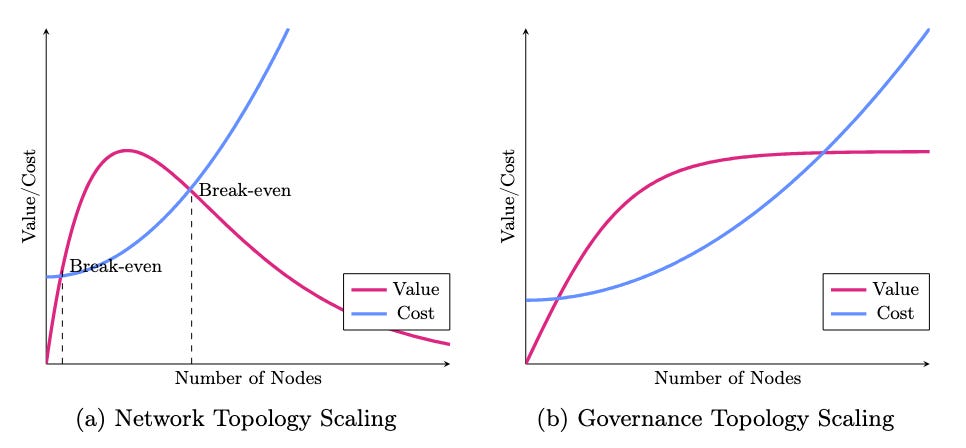
My guess is that for many scaling situations, adding new nodes to a network graph follows the sigmoid function described by Metcalfe. However, in cases such as blockchain validators, and AI agents, it might be skew normal (a lopsided bell curve, left chart below). Even if the value of adding agents is sigmoid (i.e. like the governance example, right chart below), eventually cost will outpace it, depending on what that curve looks like.
To quote Jamie Hurst,
The cost of building has collapsed, but the cost of aligning organisationally has not. If anything, it's gone up. When three different teams can each produce a working solution to the same problem in the time it used to take to write a proposal, the bottleneck moves from engineering to coordination. The MR review situation is a good example: it's now easier to build a new bot than to adopt someone else's, which means cohesion gets harder to achieve, not easier. We're solving more problems, faster, and the org-level alignment work is paying the price.
Metcalfe’s Law has been used to justify the valuation of Facebook (now Meta) and other tech stocks. However, whether or not the hyperscalers’ stock price is in any way related to value is debatable. It could be (and likely is) more about animal spirits than value.
While I think the intuition that network effects are part of any scaling story is correct, it’s notable that past a point these huge companies scale as much by acquisitions as by developing their core product. In fact, with some of the main products experiencing user decline, perhaps the argument that some external costs build up and make even these systems fundamentally inefficient in terms of their transaction economics holds water.
If network scaling issues in other domains hold true—and it is a big if—then likewise we should be wary of scaling our organisations and teams.

Going Further
Except, it’s not quite as simple as outlined above. As the graphs show, there’s actually a network topology (technical graph, containing developers and agents) and governance topology (containing the employees and agents described previously).
With this in mind, we need to adapt the bold statement from the introduction to make it clear that, as in blockchains, costs generated from the techncical operations of the organisation are expected to be accounted for in the governance of the organisation. Similarly to a blockchain, in other words. Thus:
Human staff can create value, create costs, and pay down costs in both the network topology and the governance topology of an organisation.
AI Agents can only create value in the network topology, but can create costs in both topologies.
Conclusion
Hidden costs are nothing new to technical strategists and technical leaders. We’ve known about, debated and discussed these things endlessly. We usually use the jargon TCO, or Total Cost of Ownership, rather than the more economics-y terms8 I’ve used here, but the principle is the same. AI has blown traditional ways of reasoning about, and accounting for, costs out of the water, and TCO is back to the top of the list of burning issues.
The state of the art in academia seems to show a task-contingent cost curve, referred to as A Jagged Frontier (Dell’Acqua et al., 2026), which means that the benefits of AI usage are felt unevenly.9 On average, AI use, whether supervised or not, was found to always improve output when “within the frontier,” and result in worse results outside of it.10
Taking the ideas from our last post, we could build this cost-curve based on sets of tasks, where each have different costs. This would show uneven cost of AI use, and how it contributes to total organisational cost. Figure out value per task (easy, right?)11 and you could overlay the two.
The question not addressed in the study is a longer time horizon—whether deskilling, or other factors would change this result over time, shifting the cost and value curves. Within the bounds of the study however, the result appears clear—some amount of AI use, on average, will result in better outcomes on within-frontier tasks. Any negative effects might simply be a cost of doing business in the AI age, where a black swan cost or risk generated by an out-of-frontier task could sink your project or business at any time.12
Variations on such risks have always existed.13
The good news, then, is that understanding and managing TCO was already most of the ballgame, just as things like TDD and good engineering standards were. So nothing changes, right? Because we all had everything figured out and running smoothly before the AI wrecking ball came along…
NB: An earlier version of this post did not reference Jamie Hurst’s blog post. The post was updated to include a quote.
It’s actually a heuristic, I guess, not a law. In fact, I guess to be totally pedantic, it is actually a hypothesis, confidently stated. Still, if I was operating at peak ego, I guess I’d call it Lynham’s Law.
It’s actually more complicated, and I’m attempting to simplify for the purposes of this article. The funny thing is, actually, when used in full, Metcalfe’s work does cover much of what follows.
It’s a broadcast-only network, so no costs of coordination or governance, which is fair enough, for a simplified model.
Actually it might just be Metcalfe’s Law. In a 2006 blog post, he said “There may be diseconomies of network scale that eventually drive values down with increasing size. So, if V=A*N^2, it could be that A (for “affinity,” value per connection) is also a function of N and heads down after some network size, overwhelming N^2. Somebody should look at that and take another crack at my poor old law.” I guess that ‘somebody’ is me.
Okay, they can actually pay down certain types of cost, via automating communication. But that creates further governance overhead. So the question becomes very muddy, hence my simplification for the purposes of building a mental model and intuition. The more we try and automate and pay down using the AI agents, the more it becomes a sisyphean endeavour, unless we’re careful and data-driven.
That cost is n-sub-c, found presumably by mapping it to the set it belongs, or by something more clever, such as walking its direct edges—again I’m hand-waving, but assume the function calculates cost based on the edge type, i.e. its source and destination.
The definition of this function, f, is similar to the sum function from my Decentralization post. In this case, sigma is a function that takes a given edge and returns its weight, or value. Connections in the subset of relevant edges are symmetrical, as shown below, so n-sub-e, the edge for a node, n, is in the set E. Thus the marginal node cost, n-sub-c, can be arrived at by a sum function over the return values of the edges passed in to the cost function sigma (σ).
Essentially, your org chart. Or, the number of LLM Agents per Employee. You could count and quantify this distribution a bunch of ways.
Did I really just write that? He can’t keep getting away with this!
Huge thanks to JP Vergne for making me aware of this article. Although it’s based on older models than the current frontier, the size of sample and methodology makes it very timely. I suspect their analysis holds up, but the specifics (i.e. cost curves per task) will have changed. They summarize, “Tasks that appear to human knowledge workers to be of similar difficulty may be performed either better or worse by humans using AI. Within this jagged frontier, AI can complement human work. However, outside the frontier, AI output is inaccurate, is less useful, and can degrade human performance. AI assistance improves human performance only for tasks within current AI capabilities— within the jagged technological frontier—and worsens human performance outside of it. We find that workers who skillfully navigate this frontier in their use of AI systems gain substantial quality and productivity benefits.”
Alarmingly, for the “outside the frontier” task where AI use resulted in a worse outcome, the task submissions by that group were deemed to be more persuasive than the control group—for the purposes of the persuasiveness analysis, actual correctness was not revealed to the examiners.
Wrong.
Here’s a summary of the insights I had from the paper:
(1) “within the frontier,” for knowledge workers with skin in the game, AI and AI plus oversight groups outperformed the control group.
(2) “within the frontier,” the greatest benefit of AI use was felt by the lowest-performing employees, meaning AI acted as a leveller.
(3) “outside the frontier,” the AI group performed worse, and the AI plus oversight group performed even worse.
(4) for the “outside the frontier,” task, submissions were graded on their ‘persuasiveness’—the graders were not informed of the correct solution. “[S]ubjects using AI (whether GPT + overview or GPT only) consistently out-performed those not using AI in terms of subjective coherence quality, regardless of the correctness of their answer.”
(5) that is, regardless of correctness, perceived coherence increased against the control group. So if the work is checked for both coherence and correctness, perhaps using AI is always the correct strategy—at the cost of introducing governance cost and a bottleneck elsewhere in the value chain.
After all, it was SBF’s fraud coming to light that poured jet fuel on difficult market conditions and eventually brought the blockchain ecosystem to its knees—believe me when I say you can’t plan for that stuff anyway. Then again, maybe this is disproportionately a problem with frontier tech.