
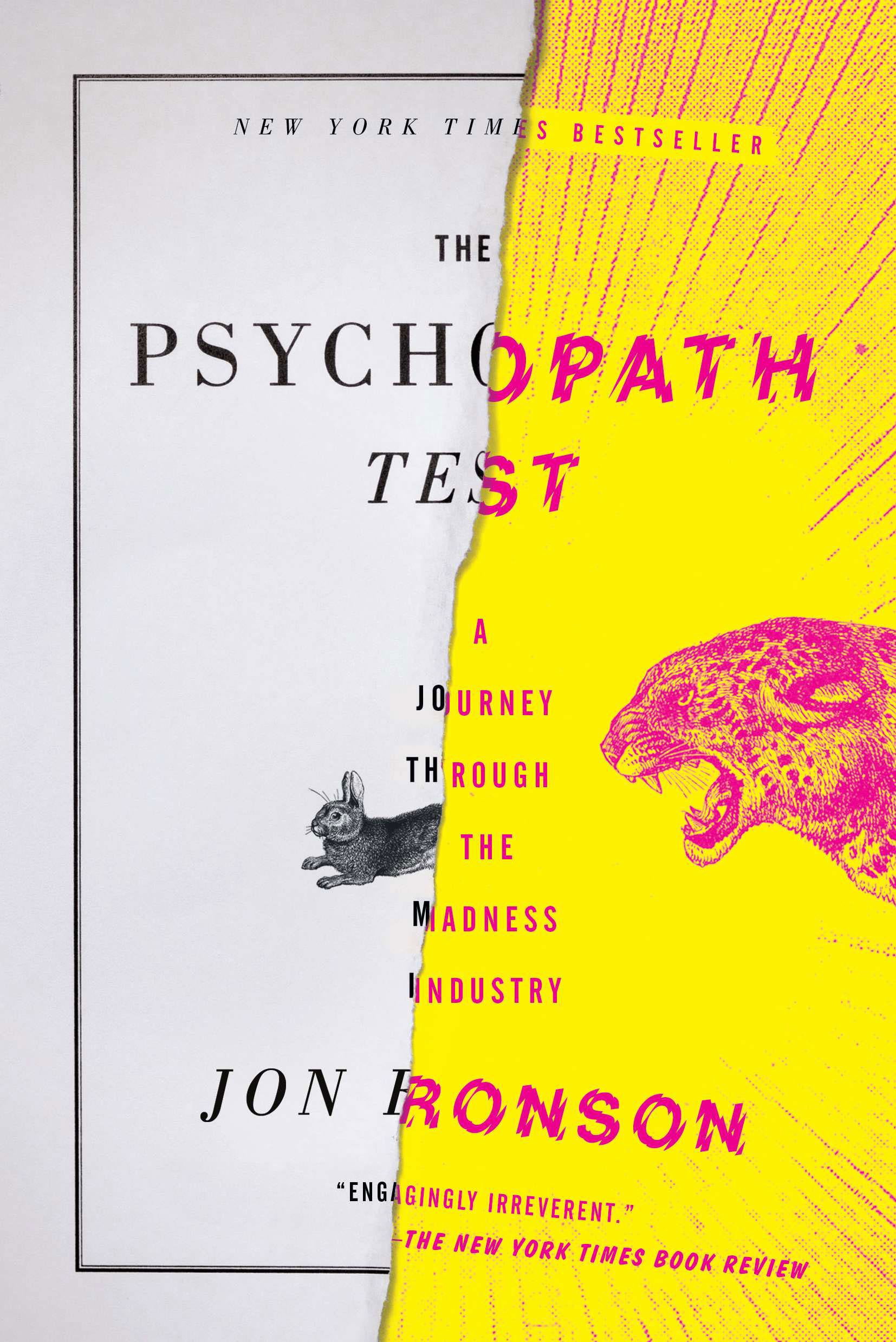
What with my recent adventures in non-clinical psychopathy (here’s the first post, the second is linked below), I thought it was worth going back to finish a book that’s been on the shelf for years—journalist1 Jon Ronson’s 2011 book The Psychopath Test.

I’ll foreground the biggest issues with the book—it is structurally muddled, and if you take a step back from the alternately shocking and humourous vignettes, you might find yourself thinking, “so what?”2
At various points, it’s not clear what conclusions the reader is supposed to draw, and by the end all I could discern was that the PCL-R is perhaps overused, and the DSM is being harmfully used to medicate children.3
It feels like a Guardian Long Read that wasn’t quite long enough for a book,
but was too long for a single article.
The first section of the book covers the definition of criminal (or clinical) psychopaths. These are the kind of individuals that you’d think of as movie villians—incorrigible and malevolent—as well as the checklist, the PCL-R, that was developed by Bob Hare to diagnose them. Bob Hare returns throughout the book, with Ronson taking his training course, and then catching up with him periodically to discuss the individuals that he meets.
To add a ‘whodunnit’ element, Ronson introduces a Broadmoor inmate—Tony—that claims he is wrongfully detained as a psychopath. Despite the stakes for the individual, the story is amusing and illustrates the broader themes pretty well.
The rest of this section is pretty fascinating, and the other people he interviews—death squad leader Emmanuel Constant and corporate restructurer Al Dunlap, are pretty good examples of the personality type.
The interview with Constant is particularly shocking and disturbing, not least because he appears to have enough self-control to not murder a passer-by in the street,4 but was happy to plan and execute crimes against humanity.
Dunlap, on the other hand, strikes me—from an armchair diagnosis—as one of the more malignant but non-criminal personalities discussed in my posts, or by many other authors on disordered personalities in leadership positions.5
However, after that point, the book loses its way a bit. The subtitle of The Psychopath Test is ‘A Journey Through the Madness Industry,’ and it is while trying to deliver on that promise that the wheels come off.
Ronson takes a detour to talk about representation of mental illness in the media, conspiracy theorists (his favourite subject) and over-medicalisation of mental disorders. It’s all interesting enough, but feels like ‘a series of articles by Jon Ronson’ rather than part of a coherent narrative.
Luckily, the most interesting section—at least according to my biases—comes right at the end.
Without giving away too much, the conclusion of the story of the Broadmoor inmate Tony allows for a nuanced discussion both with Bob Hare and another professional over the PCL-R. During that discussion, Hare points out that it’s just a checklist, and he colloquially means “very high scorers” when he says “psychopath”—that is, those that score close to the maximum.
At least in Ronson’s telling, he has a moment of pause about those potentially detained indefinitely for scoring, say, a 30 on the test. He also offers a dark observation about risk and incentives:
“Sure, Bob says, over-labelling occurs. But it’s being perpetrated by the drug companies. ‘Just wait and see what happens when they develop a drug for psychopathy. The threshold’s going to go down, to twenty-five, twenty…”6
Finally, discussion of the non-clinical psychopathic personality crops up, but it’s late, never fully defined, and Ronson doesn’t explore any other disordered personality types—naturally, I’m thinking of the Narcissitic and Machiavellian types of the Dark Triad.7
Although, as noted by the original Dark Triad paper, these other personalities share characteristics of the Psychopath, they are different personality types, and I can’t help but feel that Ronson’s missing middle chapters were probably in not being able to mine material from a discussion of these types and the relationship between them. That would have made a lot more sense, both narratively and in terms of content.
Oh well!
My summary would be that it’s a good book, though it has some real structural issues. It feels like a Guardian Long Read-type piece8 that wasn’t quite long enough for a book, and was too long for a single article.
Still, Ronson’s an engaging writer, and you can probably finish it in a couple of evenings or a single long train trip.
Comedian? Documentary-maker? All of the above? I realise as I write this how ominous it is to footnote the word ‘journalist,’ but it’s kind of funny, so I’m leaving it.
As my PhD supervisor is fond of asking me, whenever I advance what I think is a good point.
Though this point also shows the structural issues with the book—the main discussion is of ‘childhood bipolar disorder’ as a misdiagnosis of ADD/ADHD, or simply “kids being kids”—which is nothing whatsoever to do with big-P Psychopathy.
An impulse control that many ‘true’ criminal psychopaths do not have.
A point Ronson makes, and the book Snakes in Suits, co-authored by Hare himself, explores in greater depth.
The final chapter(s) cover over-diagnosis and over-medication in the context of the DSM, so presumably this was part of the discussion that Ronson and Hare were having.
Again, for more on these as well as definitions and my potted summary of what I have gleaned from research on the subject, check out my review of Nate Silver’s book On The Edge.
The Observer gave the book a positive review, with the caveat, “He skates when you want him to dig… His subject is huge and tragic and terrifying but there is something tinny and unfinished about his investigation.”