

I’m not the first to rebut this piece, but yolo, I’m doing it anyway.
I’m not the sharpest tool in the shed, but I reckon children not being able to afford food might just have an impact on productivity.
Obviously, it’s a bad faith article by The Economist, and Norman Solomon’s rebuttal points out that it’s very much in line with the political goals of the billionaires that fund the magazine.1
It’s also nothing new. In 2019 I remember The Economist writing of the need to ‘urgently resist’ Bernie Sanders and Jeremy Corbyn in a cover piece called ‘The Rise of Milennial Socialism.’
The editorial staff of The Economist don’t seem to see the connection that if the intellectual and political class repeatedly, one generation at a time, dismiss calls for a more equitable society, then all that will happen is a descent into extremism. Maybe they just don’t care.
After all, I strongly suspect that the billionaire class would rather have fascist governments that they can influence or pay off, than centrist or left-wing governments that they have to change their behaviour around, or—God forbid!—hand over some tax to. Look at who funds the reactionaries, and you’ll see a pattern.2
Okay, back to the matter at hand. There are five claims made in the article that I don’t like:
The first is that green parties like GPEW3 aren’t interested in the environment, and that these policies are “peripheral concerns.”
The second is that the left’s is a “zero-sum mindset, where a better outcome comes from not from creating, but from taking.”
Third, that wealth concentration due to AI is not a valid concern.
Fourth, that “once the left wanted higher taxation for everyone.”
Fifth, that there is even anything wrong with the reductive statement, “Now Gen-Z socialists demand handouts funded by billionaires.”
So let’s go in order.
1. The Environment Matters
The Green Party is still principally concerned with people and planet at the core of its political programme. In fact, tacking left on many peripheral issues is not, as the article suggests, because it is necessarily a “socialist” party (something I think many ex-Labour members also mistake) but because it is an outcome-focussed platform based on these two pillars.4
If people do not have the means to prosper and have a nice life then obviously that is a moral failing, but also, pragmatically, you will not be able to convince people to make any hard choices to protect the natural world for themselves, others, and their children.
The idea that the party most responsible for pushing a green transition is not interested in value creation is frankly ridiculous, doubly so when parties on the right are tripping over themselves to abolish net zero targets for purely ideological reasons.
52.5% of the UK’s energy was produced by renewables in 2025, and it is storage, capacity and distribution that are currently pulling down further gains. In an economic and geopolitical environment where natural gas supply is already both constricted and problematic, and oil is, well, both constricted and problematic, this isn’t even a fluffy green issue.
This is a national defence issue, and as probably the most hawkish Green I’ve ever met, I don’t understand why energy security as defence necessity in the long run isn’t tied more frequently to renewables and more decentralized energy production.
Before I hear another “but Greens something something NATO!” remember that (a) Trump is doing his best to dismantle the alliance, (b) there is in fact no current Green policy to leave NATO, and (c) that Greens don’t like Russian T-72s parked on their lawn any more than the next guy.5
Combine those and you’ll see why I just don’t think the criticism matters in any world where the Greens get anywhere near power. For all of the dismissive right-wing talking points, we’re actually a pretty pragmatic lot.
2. The Left’s Mindset is Not Zero-Sum
That our mindset is zero-sum is possibly the dumbest single claim.
Duh, we want to create a green economy. That’s value creating, it creates jobs, R&D, innovation. Zero-sum requires a closed system, so they’re just wrong. On a very basic level.
We, in simple terms, know that ya gotta spend money, to make money.
Greening the grid, greening transport, is going to require a huge infrastructural effort. Perhaps not on the scale of China building 50,000km of high-speed rail in 17 years, but the fact that we can’t even finish HS2 and link the Northern cities with a high-speed link (that is, an over 250km/h service) is a joke.6
Moreover, the Greens specifically are also interested in community assets, education, and opportunity. Let’s talk about that a second. Prominent economists like Mariana Mazzucato7 have spoken more eloquently than I can on how under investment in education and opportunity can have a disproportionate impact on productivity, creativity, and growth. It’s not a controversial opinion that if you spend money as public investment then you can expect a return down the line.
Subsidies and paying consumer bills to an energy supplier—now those are (potentially) non-productive uses of government money, especially if there is no new infrastructure component (as there is with e.g. cavity wall insulation, solar panels, or heat pump subsidies, etc). As a parent that benefits from free nursery hours for working parents, I hate to admit it, but this is probably an example of just giving government money away with little anticipated return.8 It’s plugging market failure rather than proactively investing in the future. Yes it means parents can work, but it’s not like free school meals for all children.
Investment in people’s futures is always a sound bet.9
On free school meals: I’m not the sharpest tool in the shed, but I’m going to put it out there that I reckon children not being able to afford food might just have an impact on productivity.10
In case The Economist need some education on the scale of the scandal here, 4m children in the UK live in poverty, with the majority (7 out of 10) having a working parent, according to the Child Poverty Action Group. Last year the Trussell Trust distributed 2.6m emergency food parcels via its community of food banks, with 900k parcels provided for children. Food bank usage is up 45% on pre-pandemic levels. Around 4% of UK individuals used a food bank in the 2023/4 year.
To give you an idea of the increase, in 2010/11, the Trussell Trust “distributed around 60,000 emergency food parcels.” That’s a 43-fold increase. I can’t even begin to describe how angry this makes me as a parent of young children. It is obscene.
Does The Economist need me to explain how investment works?
The whole point of investment in public services, infrastructure, young people, healthcare, education and other initiatives is not only the moral imperative to improve the lives of people in this country, but also the slightly less altruistic knowledge that doing so will result in a healthier economy in the long run.
But yes, whatever, we’re zero-sum, take take take.
No. You know who is take take take? The right. Their billionaire backers. The management consultants. The spineless execs of companies that are always seeking “to do more with less.” Remember that under austerity, a cowardly, ideologically-motivated policy, the UK underinvested to the tune of hundreds of billions of pounds:11
“The cost of failing to maintain [the existing] rate of public spending growth, and instead imposing spending cuts, came to £91bn of lost public expenditure in the final year of the austerity programme, or £540bn over 2010-19.”
Remember also that the private sector underinvested too. So a lack of vision, and conservatism about the future is not just limited to the political class. It’s why British deep tech startups such as Deepmind and ARM eventually seek investment from elsewhere, often being acquired by US tech giants.
Left-of-centre think-tanks naturally have criticised austerity as counterproductive; but the approach taken in the UK was even somewhat at odds with that well-known hotbed of radical thinkers, the IMF, a fact that was seized on by John McDonnell at the time.12 The reason will be familiar to anybody that’s done GCSE Economics, that the distribution of wealth and income is important, because people spend unevenly; thus, “[i]ncreased inequality in turn hurts the level and sustainability of growth.”
Even as these private sector ‘leaders’ continue to add no vision and no guts, and low-to-no investment to our economy, they are content to give themselves record bonuses and talk at conferences about how innovative they are.13
So here we are, hundreds of billions of investment short in the public sector, and even more short in the private sector. Many of our pressing issues share the same shape.
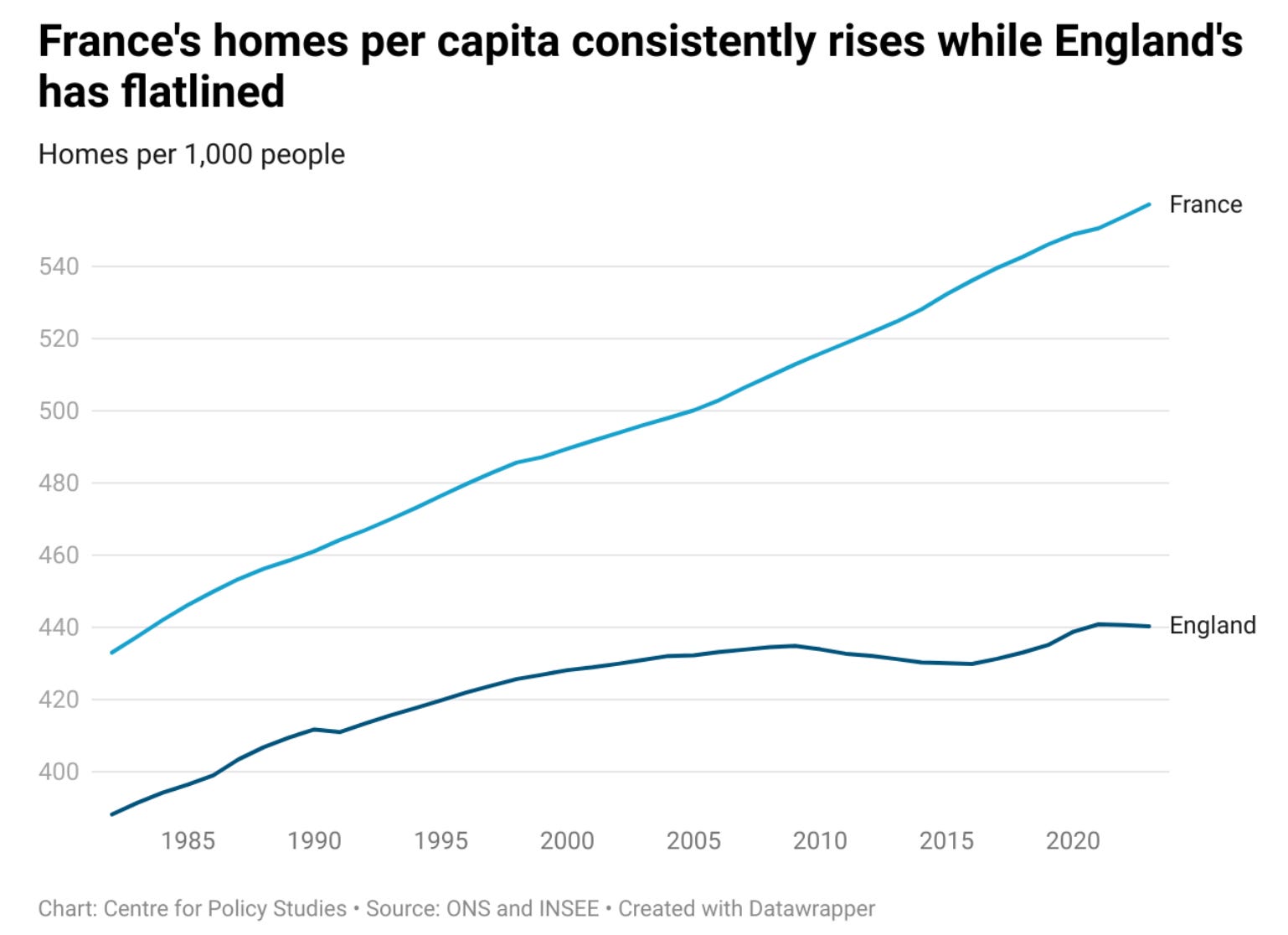
The 6.5m homes housing gap? Look at a chart of housing in the UK and France and note where austerity comes in. It might not quite be a case of, “it’s the economy, stupid,” but it’s probably a case of, “it’s under investment, stupid.”
If, however, by “take take take” what The Economist means is that we favour redistributive policies, then yes we do. I’ll talk about that in Section 4.
3. Concerns About AI Are Valid, Actually
I’ve written a three part series on AI, and you can read many other much better writers on the subject (links in those posts). This is well-worn ground both for the commentariat, and also in terms of historical context.
The social concerns are valid. The economic concerns are valid. The artistic concerns are valid.
Look, I suspect the tooling is pretty useful, as in, gives you a 3-10% increase in productivity (that isn’t nothing!), and I wrote in Part 3 of that series about how I and others leverage it. I’ve also discussed how small companies may disproportionately benefit, and that this presents an opportunity, because the maths of scaling it all may not add up for big or legacy organisations. That’s competitive advantage, folks!
!["I didn't grow up dreaming of prompting." [Part 1]](https://substackcdn.com/image/fetch/$s_!L6sB!,w_140,h_140,c_fill,f_webp,q_auto:good,fl_progressive:steep,g_auto/https%3A%2F%2Fsubstack-post-media.s3.amazonaws.com%2Fpublic%2Fimages%2F1925e178-04d8-4964-ab62-f0edc6caf99d_3000x1000.png)
However. I’ll just say that it looks really out of touch to mock concerns about AI when young people are facing a collapse in jobs and opportunity on the one hand, and being told by billionaire AI bros on the other hand that all their problems will be solved by the thing that conveniently, those same AI bros are selling.
Hey, look! It’s an article in The Economist about the problems of rising AI usage bills.
The kids aren’t stupid. The kids are alright.
4. Let’s Talk Taxes
Do I have to explain progressive taxation to The Economist?14
Let’s be charitable and assume that’s what they mean by this talking point. To which we then say... er, yes? If you create inflation (growth) but don’t control how that is distributed, the common result is wealth concentration.
The point of wealth taxes is to tax wealth, not work. It doesn’t mean that high earners couldn’t pay a bit more than they currently do. Taxes aren’t mutually exclusive as policy levers. Higher income tax in the top band is a reasonable deal, in fact, in the context of an economy that could (and should) bring back in free university and vocational education.
Personally, I think wealth taxes are a bit of a red herring—they don’t bring in enough to be transformational, but they bring in something.15 You’re going to have to also change other progressive taxes (income tax) and reform council tax in order to get enough money to have credible, transformational, spending plans.
I remember when, as a student in 2006 the UK finally paid off its World War Two debts. As a result, I was delighted to see these interviews with Mariana Mazzucato where she points out—correctly—that we can always find money to fight a war, and those kinds of long-term debts are not factored in to whether financial markets will lend money to an economy in the Global North.
Austerity was justified using an analogy (that the national budget functions like a household) that is incorrect—and the structure of long-term debt for things like war loans bears this out. Some kinds of spending are always possible, if the justification is deemed “good enough.”
The same is true of a programme to fix the UK economy. If it is credible, the money will be there.
This is why we don’t need to worry too much about the bond markets so long as we can articulate a long-term economic plan that sounds credible. Truss’s failure was being less convincing than a lettuce, and using uncosted, vibes-based tax cuts. We can do better. Much better.
If The Economist is also talking about initiatives like LVT16 (which I am not sure the Greens currently have a position on), then there is evidence that this would be a net positive for most households in the UK, representing a good way of not only making Council Tax fairer across the UK, but also working towards redistribution.
Finally, let’s talk again about wealth concentration. As another Progressive Economy Forum working paper notes, in the UK since 1980, “the market value of privately held wealth (property, physical and financial assets net of debt) has risen at more than twice the pace of the economy, a pattern repeated across the globe.” No surprise that this broadly has coincided with successive tax cuts for the rich.
Trickle-down economics, the Reagan-era idea that making the rich richer17 benefits all participants in an economy, has been pretty roundly debunked at this point. Moreover, it’s part of the reason that Liz “the lettuce” Truss’s mini budget was rejected by the markets—it’s as if somebody read Naomi Klein’s The Shock Doctrine and went, “oh yeah, great idea!”
Anyway, the paper debunking trickle-down economics that I referenced just now was the most downloaded LSE-hosted research paper ever, and is worth a read. There’s some cracking lines in the cover article, however:
In explaining why cutting taxes for the rich did nothing to boost economies, Dr Hope referred to the economist Thomas Piketty, who argues that unless capitalism is reformed, it will threaten the democratic order.
“Our results align pretty closely with some work from Thomas Piketty, that would suggest that what happens if you cut taxes on the rich is that they then bargain more aggressively for their own compensation at the direct expense of workers lower down the income distribution. So, the story of the paper then is really to do with rent-seeking among CEOs and top executives—and that increasing when you have lower taxes on the rich.”
Rent-seeking is the effort to increase one’s share of existing wealth without creating new wealth—rather like a greedy child demanding a bigger slice of the pie so that there’s less left on the plate for everyone else.
I like this quote because it also neatly explains rent-seeking. Rent-seeking crops up all over the modern economy, but not just in housing, which is a common misconception.
Those of us who were in crypto for reasons other than pure gambling18 were likely in it because the economic model of web2 encourages the development of rent-seeking platform capitalism (Varoufakis) or vector capitalism (McKenzie Wark), two different terms for monopolistic, rent-seeking behaviour. Think the business model of Amazon, Uber, et cetera—that’s classic rent-seeking.
Perhaps the most disappointing thing about web3 is that many blockchain Foundations essentially re-created the platform or vector capitalist model of coercion and centralization in their blockchain economies, something I’ve written about in conference papers presented at FCiR25 and SDLT9.
Anyway, back to the point: in an economy struggling with flat productivity, flat growth, and rising inequality, rents are problematic, non-productive capital is problematic, and it’s not just radicals that think or have thought so. Imagine my suprise that Winston Churchill of all people agrees with me:
Land Monopoly is not the only monopoly, but it is by far the greatest of monopolies—it is a perpetual monopoly, and it is the mother of all other forms of monopoly.
Unearned increments in land are not the only form of unearned or undeserved profit, but they are the principal form of unearned increment, and they are derived from processes which are not merely not beneficial, but positively detrimental to the general public.
Wealth taxes are an attempt to curtail the impact of rent-seeking. Frame it that way and they are a class of taxes addressing a very broad problem.
5. Siding With Billionaires is Pathetic
Billionaires have the money to spare.19
“But they’ll leave!” They already live extra-juristictional lives, for the most part. In so far as we have any ability to force the matter, we should say, pay your share or GTFO.
These people aren’t afraid of us, they aren’t afraid of the state, and they should be.20 A journalist friend of mine memorably recounted a discussion where a politician had said, “how do you deal with a man as powerful as Elon Musk?” To me, in the retelling, he quipped, “the SAS.”
The landlord class have always been economically distorting and non productive and this crop are no different. That’s the most charitable read I have.
The argument against wealth accumulation in the renter class is not a new one. I hope I made that case adequately in the last section.
Adam Smith, John Stuart Mill, Lloyd George and Winston Churchill have all argued that rents are non-productive for an economy, and in an environment where investment (both private and public) is acutely needed, taxing and discouraging private renting in favour of investment in other areas of the economy is hardly a crackpot idea.
Plus, if you side with billionaires over your family, friends and community, you’re a bootlicker. Sorry, but there it is.
Let’s Wrap This Up
I’m a long-time subscriber to Private Eye, and there’s a tradition in that magazine to end furious letters with, “I will not be cancelling my subscription.”
The same is true here. The Economist remains one of the few news outlets that seem to bother with fact-checking and basic journalistic standards,21 even if I generally don’t care for their worldview.
However, this is a dismal, dismissive effort that can’t go unchallenged.
In exchange for hard work, people want a nice life. They want dignity. And boy, that is a hill I will happily die on.
“The investment company Exor, controlled by one family with $38bn in net assets, has the biggest stake in the magazine. Meanwhile, the investor with more than a quarter interest in the Economist, the Canadian businessperson Stephen Smith, has a personal net worth of $6.9bn.” (For sources, check the original article)
I mean, do I need to say Elon Musk? Elon “Seig Heil” Musk.
The Green Party of England and Wales.
There is also an implication that the parties of the left are mainly focussed on identity politics. This holds more water insofar as every party is playing the game of identity politics at present. The problem here is the characterization of e.g. LGBT+ policies versus e.g. ethno-nationalism. Trans rights? Obviously the left is playing at identity politics! Flying flags on lamp posts? No comment. There’s a hypocrisy to this claim that sticks in my craw because fundamentally all politics has become an appeal to narcissism, and if you were to pose me the question: ‘is it imperative we rise above the politics of narcissism?’ I would say, yes, of course. However, the idea that it is only a problem of the left is ridiculous.
I mean, at this point they’re probably desperate enough that they’re using T-55s, but the point stands.
Obviously I see these infrastructural projects as essential, but the hard discussion about how you balance the damage to the environment has not yet been had. We have a great scarcity of nature in Britain—look at the stats of bird numbers declining even in my lifetime, which accelerated after 2010—so any development programme also needs to be offset by creating spaces for wildness to flourish. That might be new national parks, that might be rewilding marginal farmland (e.g. marginal sheep pasture in the Lakes), but the conversation is important. Doubly so since greenbelt is going to have to be built on to address the housing crisis. We have a visceral sense of loss when faced with the loss of any of these green or wild spaces, and we need a positive plan to offset any necessary losses. More than offset, we need to create a greater abundance of nature in the UK.
Not shilling Mariana just because she’s based at UCL (pun intended), I promise. You should watch these interviews.
I’m happy to be corrected on this, however.
Especially young people.
What do you reckon, readers?
Mazzucato quotes £500bn underinvestment under austerity, which is I think from this publication from a left-wing think-tank, summarized here. I’m biased, obviously, but the core argument is damning if correct: “Using figures from the Office for Budget Responsibility, the paper demonstrates that governments from 2010 onwards could have maintained historic rates of growth in public spending and still have reduced Britain’s government debt burden by 2019… Despite claims by Coalition and Conservative governments that austerity was necessary to restructure the economy and promote growth, the research shows that the primary economic impact of austerity was through weakening the bargaining position of labour rather than boosting business investment, undermining real wages and job security over the 2010s. “Expansionary fiscal contraction”, as promoted by government supporters at the time, did not take place.”
“An assessment of [austerity] (rather than the broad neoliberal agenda) reaches three disquieting conclusions:
- The benefits in terms of increased growth seem fairly difficult to establish when looking at a broad group of countries.
- The costs in terms of increased inequality are prominent. Such costs epitomize the trade-off between the growth and equity effects of some aspects of the neoliberal agenda.
- Increased inequality in turn hurts the level and sustainability of growth. Even if growth is the sole or main purpose of the neoliberal agenda, advocates of that agenda still need to pay attention to the distributional effects.”
Look, I’ve met daring, bold, innovative senior leaders in companies, but it’s very much an 80-20 deal. In fact, even that is generous.
This is a lazy rhetorical device, I know, but one bad-faith turn deserves another, I guess.
Wealth tax campaigner Gary Stephenson quoted Milton Friedman in one of his videos, specifically, “Only a crisis — actual or perceived — produces real change. When that crisis occurs, the actions that are taken depend on the ideas that are lying around.” This makes me believe that Stephenson probably knows Wealth Taxes are part of the toolkit but are either only a small part of the solution, or causally reversed from his public claims. I suspect his campaign is at least partly because a narrative against the far right needs to be made, and “tax the rich!” ain’t a bad one, so far as they go. As for causal reversal, I mean that inequality is a symptom of policies that cause less stable, less productive economies, but it is not the driver. I guess, in a sense, I have argued the opposite thing here, that inequality can depress productivity, and become the negative multiplier, but I guess I would term it something more like the Social Contract since it covers childhood nutrition, wages, income tax, et cetera—not just wealth inequality, which is only a single dimension. Still, maybe we are in fact talking about the same thing.
Land Value Tax. There have been some interesting theories about what this would mean for reforming Council Tax.
A convenient thesis, I know.
I can’t believe I had to type that, but here we are. I guess every penny I’ve laid out on education was well-spent eh?
Okay, another take, as I alluded to in the introduction, is that they are afraid of us, they are afraid of the state, and that’s why they are trying to destabilise our democracies, because then we can’t get organised and curtail their power.
Many, many years ago I interned at the news digest The Week, and it was one of only two newspapers you could assume would have actually fact-checked their stories (the other was the FT). Every other paper had to have its claims corroborated or fact-checked by our team, and editorial notes added where appropriate. Though it was twenty years ago, if I remember correctly, the rule of thumb was to assume one external reference was needed for The Guardian and Times, two for the Telegraph or Independent, and the red tops you should assume any story was made up unless you could prove otherwise. Since you’re here, I’d also say I rate the various Politico digests (which didn’t exist at the time).